Free Iowa DMV Motorcycle Practice Test 2026
The Iowa Motorcycle knowledge test has ~25 questions, and you need ~20 correct (~80%) to pass. Practice free with questions written from the official Iowa driver handbook — every one has a clear explanation, and you can retake as often as you like with no sign-up.
Content reviewed against official driver handbooks · August 12, 2026
What's on the Iowa written test
The Iowa Motorcycle knowledge test has ~25 questions; you need ~20 correct (~80%) to pass.
Based on the official Iowa exam format — always confirm current details with your state DMV.
Practice by topic
Focus on one area at a time — each topic has its own set of Iowa practice questions.
Helmets, eye protection, and abrasion-resistant gear — what the motorcycle handbook requires and why each piece matters in a crash.
Throttle, clutch, both brakes, and shifting — the controls you must operate smoothly before the road test.
Countersteering, the slow-look-press-roll technique, and choosing the right line through a curve at motorcycle speeds.
Using both brakes together, stopping quickly without locking a wheel, and recovering from a skid.
Where to position yourself in the lane to be seen, managing blind spots, and sharing the road safely with cars and trucks.
Conspicuity — reflective and bright clothing, headlight use, and lane position that make a rider easier for drivers to see.
Gravel, wet pavement, grooved roads, and railroad tracks — reading and handling surfaces that matter far more on two wheels.
Learn the shapes, colors, and meanings of regulatory, warning, and guide signs — from stop and yield to construction and school-zone signs.
Speed limits, turning and signaling rules, headlight and seat-belt requirements, and the everyday laws every driver must follow.
Who goes first at intersections, four-way stops, roundabouts, and crosswalks, and how to yield to pedestrians and emergency vehicles.
Blood alcohol limits, zero-tolerance and implied-consent laws, and how alcohol and drugs — legal or not — affect your driving.
How to pass the first time
- Read the official Iowa driver handbook at least once before test day.
- Practice by topic to find your weak spots, then fix them.
- Take full-length practice tests until you pass comfortably every time.
- Read every explanation — understanding beats memorizing.
Iowa Motorcycle test — frequently asked questions
How many questions are on the Iowa Motorcycle test?
The Iowa Motorcycle knowledge test has ~25 questions, and you need ~20 correct (~80%) to pass. Our practice tests mirror that format.
How many questions can I miss on the Iowa Motorcycle test?
You can miss up to ~5 of the ~25 questions and still pass — you need ~20 correct, which is ~80%.
Can I retake the practice test?
Yes — practice as often as you like, completely free. The questions and answer choices are shuffled each time.
Can I take the Iowa practice test in Spanish?
Yes. Every question here is available in English and Spanish — switch languages anytime. Many states also offer the real knowledge test in languages other than English; confirm what Iowa offers with your DMV.
Can I practice on my phone?
Yes. The practice tests work in any mobile or desktop browser — no app or sign-up needed — so you can study anywhere.
Are these the real DMV test questions?
No. Our questions are original, written from the current official Iowa driver handbook to match the real test's topics and style. We are not affiliated with any DMV or government agency.
What's the best way to study?
Read the Iowa driver handbook, practice by topic to target weak areas, and finish with full-length tests until you consistently pass.
Other Iowa practice tests
Take the Motorcycle test in another state
Every Iowa question is written from the official Iowa driver handbook and checked against its current edition. DMV Test Free is a free, independent study resource — not affiliated with any DMV or government agency. About DMV Test Free
Iowa Motorcycle questions with answers
20 sample questions from the Iowa Motorcycle question bank — each with the correct answer, a short explanation, and the section of the official handbook it comes from.
Show all 20 questions with answers
1. A dog runs out and chases your motorcycle. What does the manual say larger animals such as deer or cattle require instead?
Correct answer: Braking and preparing to stop, because they behave unpredictably
Big animals get a different response from a dog: the manual says to brake and be ready to stop, since deer, elk and cattle are unpredictable.
Source: Iowa Motorcycle Operator's Manual — Animals
2. You are about to ride a motorcycle you have never used before. What does the manual tell you to do first?
Correct answer: Locate and work the signals, horn, light switch, fuel valve and cut-off switch, and try the throttle, clutch, brakes and shifter before you set off
The manual says to find every control without having to hunt for it and to work the throttle, clutch, brakes and shifter a few times before riding an unfamiliar machine.
Source: Iowa Motorcycle Operator's Manual — Know Your Motorcycle, Get Familiar with the Motorcycle Controls
3. What does the Iowa manual identify as the leading cause of traffic-related deaths in the state?
Correct answer: Failing to yield the right-of-way
The manual states plainly that failure to yield is the number one cause of traffic fatalities in Iowa.
Source: Iowa Driver's License Manual — Chapter 2, Intersections
4. Why can the front brake be applied harder once a stop is already under way?
Correct answer: Because weight shifts forward, giving the front tire more traction to use
As the motorcycle's weight transfers to the front, more traction becomes available there, so the front brake can take more pressure than it could at the start.
Source: Iowa Motorcycle Operator's Manual — Basic Vehicle Control, Braking
5. Why does the manual forbid riding directly beside another rider in the same lane?
Correct answer: It leaves you nowhere to go if you must maneuver around a car or a hazard
Pairing up removes your room to maneuver; the manual says to wait until you are both stopped if you want to talk.
Source: Iowa Motorcycle Operator's Manual — Group Riding, Don't Pair Up
6. The manual names particular moments when a mirror check matters most. Which of these is one of them?
Correct answer: While waiting at an intersection, watching what comes up behind you
Sitting at an intersection is on the list, along with before a lane change and before slowing, because a driver who is not paying attention can arrive on top of you.
Source: Iowa Motorcycle Operator's Manual — Increasing Conspicuity, Using Your Mirrors
7. In the first step of the turning sequence, how do you reduce speed?
Correct answer: By closing the throttle and, if you need more, using both brakes
Speed comes off before the turn: roll the throttle closed and add both brakes if that is not enough.
Source: Iowa Motorcycle Operator's Manual — Basic Vehicle Control, Turning
8. At roughly what rate does the body clear alcohol, according to the manual?
Correct answer: About one drink an hour
The body eliminates close to one drink per hour, so drinking faster than that leaves alcohol accumulating in your system.
Source: Iowa Motorcycle Operator's Manual — Alcohol in the Body, Blood Alcohol Concentration
9. At a railroad crossing, a small number sign hangs beneath the crossbuck. What does that number mean?
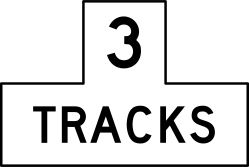
Correct answer: How many sets of tracks you must cross
The number under the crossbuck tells you how many sets of tracks lie across the road at that crossing.
Source: Iowa Driver's License Manual — Chapter 2, Traffic Signs
10. Which vehicles are required to halt between 15 and 50 feet ahead of railroad tracks?
Correct answer: School and charter buses, anyone driving passengers for hire, and vehicles that must carry hazardous-materials placards
The stopping requirement applies to school and charter buses, for-hire passenger carriers, and hazardous-materials vehicles, unless an officer or signal directs traffic through or the crossing is marked exempt.
Source: Iowa Driver's License Manual — Chapter 2, Railroad Crossings
11. What does the manual say about the boots or shoes a rider should choose?
Correct answer: They should be tall enough to cover and support the ankle, with hard slip-resistant soles and short heels
The manual asks for footwear that covers and supports the ankles, soles of hard durable slip-resistant material, low heels, and laces tucked away.
Source: Iowa Motorcycle Operator's Manual — Wear the Right Gear, Clothing
12. Just before the front tire contacts an obstacle, what does the manual suggest doing with the throttle?
Correct answer: Roll on a little to lighten the front end, then roll back off
A quick small roll-on lightens the front end just before contact, and the throttle is rolled straight back off afterward.
Source: Iowa Motorcycle Operator's Manual — Handling Dangerous Surfaces, Uneven Surfaces and Obstacles
13. How far forward should you sit on the seat, according to the manual?
Correct answer: Far enough forward that your arms bend slightly at the handgrips
Sitting forward enough to leave a slight bend in the arms lets you press on the bars without stretching for them.
Source: Iowa Motorcycle Operator's Manual — Basic Vehicle Control, Body Position
14. A person ahead of you is walking with a white cane tipped in red, led by a harnessed service animal. What does the manual say?
Correct answer: The person is likely visually impaired, so use extra caution to avoid injuring them
A white cane, or a white cane with a red tip, and a harnessed service animal both signal a visually impaired pedestrian, and drivers are told to take extra care.
Source: Iowa Driver's License Manual — Chapter 2, Sight-Impaired Pedestrians
15. How should the brakes be checked during the tires-and-wheels portion of a pre-ride inspection?
Correct answer: Try each lever on its own, checking that it feels firm and will hold the motorcycle
The manual asks you to try the front and rear brakes one at a time and confirm that each feels firm and holds the machine when fully applied.
Source: Iowa Motorcycle Operator's Manual — Know Your Motorcycle, Check Your Motorcycle
16. You are following a car. Which part of the lane usually puts you where the driver can see you?
Correct answer: The middle of the lane, which places you in the inside rearview mirror
Most drivers check the inside rearview mirror far more often than the side mirrors, and the middle of the lane is what puts you in that view.
Source: Iowa Motorcycle Operator's Manual — Keeping Your Distance, Following Another Vehicle
17. Which clothing colors does the manual recommend for being noticed?
Correct answer: Bright orange, red, yellow or green
Bright orange, red, yellow and green jackets or vests are named as the best choices, and reflective bright-colored gear is better still.
Source: Iowa Motorcycle Operator's Manual — Increasing Conspicuity, Clothing
18. What does the manual name as a leading cause of crashes that involve only the motorcycle?
Correct answer: Riders drifting wide through a curve or turn
Running wide in a corner is called out as a primary cause of single-vehicle motorcycle crashes.
Source: Iowa Motorcycle Operator's Manual — Crash Avoidance, Curves
19. Why does cannabis pose a particular problem for motorcyclists, according to the manual?
Correct answer: It distorts perception of time, space and speed, which riders must judge constantly
Cannabis warps the sense of time, space and speed, and riders depend on continual fine judgment of complex traffic and split-second control inputs.
Source: Iowa Motorcycle Operator's Manual — Cannabis and Motorcycle Operation
20. A reflective orange triangle is mounted on the back of a vehicle ahead of you. What does it mean?
Correct answer: The vehicle travels at 35 mph or less
The orange triangle is the slow-moving vehicle emblem, marking a vehicle that travels no faster than 35 mph, such as farm equipment or a horse-drawn wagon.
Source: Iowa Driver's License Manual — Chapter 2, Slow-Moving Vehicle Sign