Free Nevada DMV Car / Permit Practice Test 2026
The Nevada Car / Permit knowledge test has 25 questions, and you need 20 correct (80%) to pass. Practice free with questions written from the official Nevada driver handbook — every one has a clear explanation, and you can retake as often as you like with no sign-up.
Content reviewed against official driver handbooks · August 12, 2026
What's on the Nevada written test
The Nevada Car / Permit knowledge test has 25 questions; you need 20 correct (80%) to pass.
Based on the official Nevada exam format — always confirm current details with your state DMV.
Practice by topic
Focus on one area at a time — each topic has its own set of Nevada practice questions.
Learn the shapes, colors, and meanings of regulatory, warning, and guide signs — from stop and yield to construction and school-zone signs.
Speed limits, turning and signaling rules, headlight and seat-belt requirements, and the everyday laws every driver must follow.
How to read traffic signals, lane lines, and pavement markings — including yellow and white lines, arrows, and flashing lights.
Who goes first at intersections, four-way stops, roundabouts, and crosswalks, and how to yield to pedestrians and emergency vehicles.
Following distance, scanning, blind spots, using your lights, and the habits that prevent crashes and keep you in control.
Driving safely around motorcycles, bicycles, large trucks, pedestrians, and school buses — and knowing who has the right of way.
Blood alcohol limits, zero-tolerance and implied-consent laws, and how alcohol and drugs — legal or not — affect your driving.
Legal and illegal parking, colored curbs, distances from hydrants and crossings, and how to park safely on hills.
Choosing a safe speed, keeping a space cushion, adjusting for weather and traffic, and understanding stopping distance.
What to do when things go wrong — brake failure, tire blowouts, skids, and stalling on railroad tracks.
The point system, license suspension, provisional-license rules, insurance requirements, and other licensing basics.
How to pass the first time
- Read the official Nevada driver handbook at least once before test day.
- Practice by topic to find your weak spots, then fix them.
- Take full-length practice tests until you pass comfortably every time.
- Read every explanation — understanding beats memorizing.
Nevada Car / Permit test — frequently asked questions
How many questions are on the Nevada Car / Permit test?
The Nevada Car / Permit knowledge test has 25 questions, and you need 20 correct (80%) to pass. Our practice tests mirror that format.
How many questions can I miss on the Nevada Car / Permit test?
You can miss up to 5 of the 25 questions and still pass — you need 20 correct, which is 80%.
Can I retake the practice test?
Yes — practice as often as you like, completely free. The questions and answer choices are shuffled each time.
Can I take the Nevada practice test in Spanish?
Yes. Every question here is available in English and Spanish — switch languages anytime. Many states also offer the real knowledge test in languages other than English; confirm what Nevada offers with your DMV.
Can I practice on my phone?
Yes. The practice tests work in any mobile or desktop browser — no app or sign-up needed — so you can study anywhere.
Are these the real DMV test questions?
No. Our questions are original, written from the current official Nevada driver handbook to match the real test's topics and style. We are not affiliated with any DMV or government agency.
What's the best way to study?
Read the Nevada driver handbook, practice by topic to target weak areas, and finish with full-length tests until you consistently pass.
Other Nevada practice tests
Take the Car / Permit test in another state
Every Nevada question is written from the official Nevada driver handbook and checked against its current edition. DMV Test Free is a free, independent study resource — not affiliated with any DMV or government agency. About DMV Test Free
Nevada Car / Permit questions with answers
20 sample questions from the Nevada Car / Permit question bank — each with the correct answer, a short explanation, and the section of the official handbook it comes from.
Show all 20 questions with answers
1. An ambulance approaches with lights flashing and siren sounding. What should you do?
Correct answer: Pull to the right, clear of any intersection, and wait until it passes
Move promptly to the right edge of the roadway but never park yourself inside an intersection, because that blocks the very path the emergency crew needs.
2. How are major offenses such as DUI handled under the demerit system?
Correct answer: No points are assigned; the license is revoked instead
Serious offenses bypass the point ladder altogether. A DUI conviction or causing substantial bodily harm results in revocation on its own.
Source: Nevada Driver's Handbook — Chapter 9, Demerit Point System
3. Smoke is coming from under the hood. What does the handbook tell you to do?
Correct answer: Pull off, shut off the ignition, open the hood cautiously, and if the fire cannot be controlled move at least 100 feet away
Water is the wrong tool because burning fuel floats on it and spreads. Sand or dirt can smother a small fire, and distance is the answer when it cannot be stopped.
Source: Nevada Driver's Handbook — Chapter 5, Driving Emergencies
4. Oncoming headlights are dazzling you on a dark Nevada road. What should you do?
Correct answer: Shift your gaze downward and toward the right side of your lane
Looking down and to the right keeps the glare out of your eyes while the edge line or lane marking guides you until the other car has gone by.
5. A single lane is marked for right turns only. What does that mean for a driver going straight?
Correct answer: They may not travel through the intersection while in that lane
A dedicated right-turn lane may only be entered by drivers who are actually turning right. Continuing straight from it through the intersection is not allowed.
6. Why is tailgating a commercial truck especially risky?
Correct answer: The truck driver cannot see you there and you cannot see the road beyond the trailer
Directly behind a trailer sits a large blind area, and it also hides everything happening ahead of the truck, leaving you nowhere to go if it stops suddenly.
Source: Nevada Driver's Handbook — Chapter 6, Commercial Vehicles
7. Nevada uses a pennant-shaped sign along the left side of a roadway to indicate what?
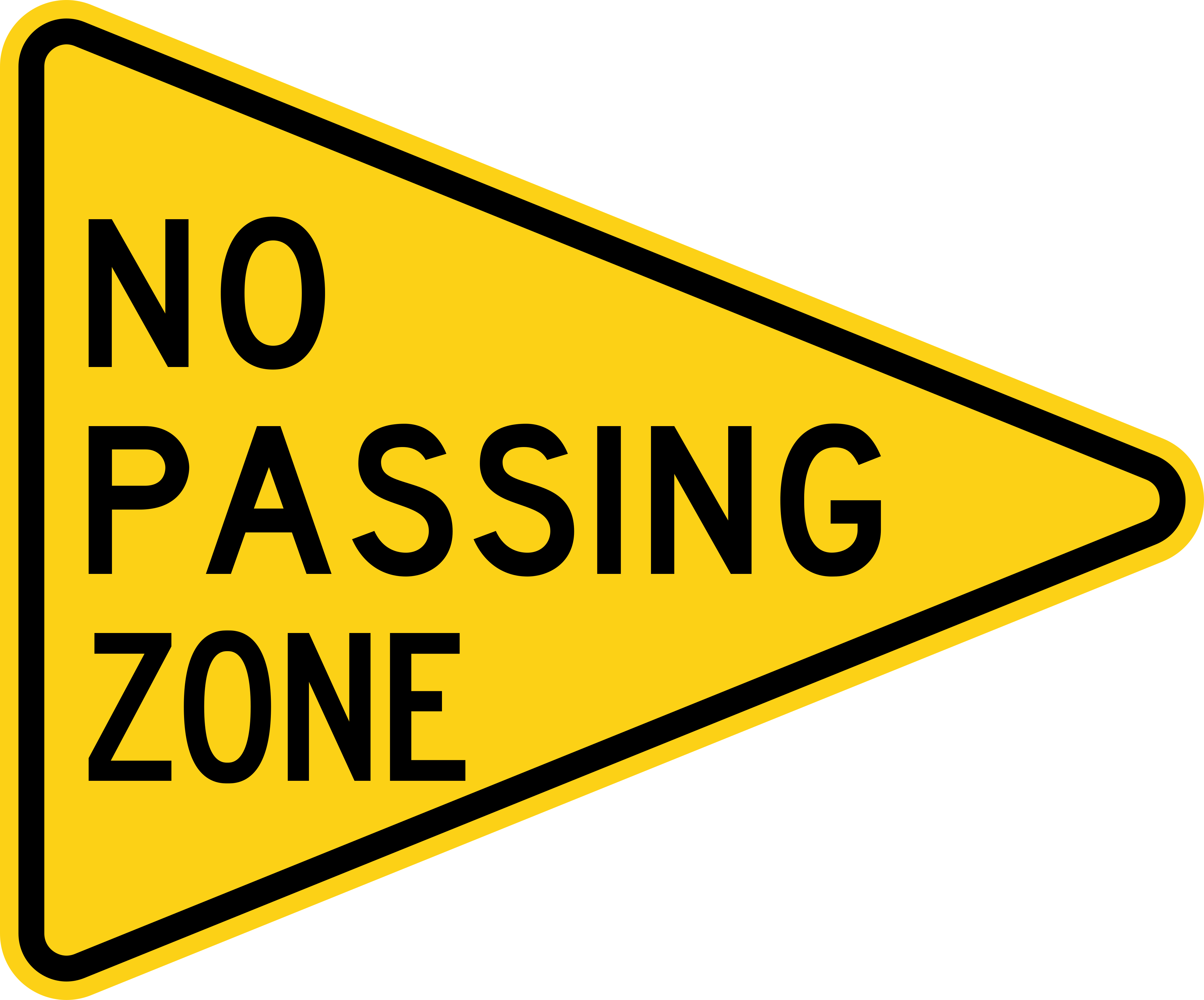
Correct answer: Passing is not allowed
The long, narrow pennant is the shape assigned to no-passing zones. Seeing one means you must stay behind the vehicle ahead until the zone ends.
8. What does the handbook give as a normal driver reaction time?
Correct answer: Roughly 2 to 2.5 seconds
Reaction time covers seeing the problem, deciding, and moving your foot to the pedal. It stretches further when the situation is complicated or unexpected.
9. Which of these parking practices does Nevada prohibit?
Correct answer: Leaving your car beside another vehicle already parked at the curb
Pulling up alongside a car that is already at the curb is double parking. Bridges, tunnels, sidewalks, intersections and bike lanes are also off limits.
Source: Nevada Driver's Handbook — Chapter 3, No Parking Allowed
10. Nevada's open container law does not reach which of these spaces?
Correct answer: The living area of a motor home
Opened alcohol is barred from the driver and passenger areas of a moving vehicle, but the rule spares motor home and house trailer living quarters as well as the passenger areas of buses, limousines and taxis.
Source: Nevada Driver's Handbook — Chapter 10, Other DUI Laws
11. Under what condition does Nevada allow a left turn against a red signal?
Correct answer: Turning off a one-way street onto another street that is also one-way, with its traffic flowing leftward
The only left turn on red permitted is one-way to one-way, where the receiving street's traffic flows leftward. You must still stop first and let people on foot and other traffic go.
12. You are on an entrance ramp merging onto a Nevada freeway. Who has priority?
Correct answer: Traffic already on the freeway
Vehicles on the freeway keep the right to continue. Use the acceleration lane to match their speed and slide into a gap rather than forcing your way in.
13. How long do DUI-related convictions remain on a Nevada driving record?
Correct answer: Seven years
Convictions tied to driving under the influence stay for seven years, while most other violations are reportable to insurers for three.
Source: Nevada Driver's Handbook — Chapter 9, Your Driving Record
14. Your car stalls on a railroad crossing. What does the handbook direct?
Correct answer: Get out at once, find the blue emergency notification sign at the crossing, and call the railroad and local law enforcement
Abandon the vehicle first. The blue sign posted at the crossing carries the number that reaches the railroad directly so trains can be halted.
Source: Nevada Driver's Handbook — Chapter 3, Railroad Crossings
15. What visual routine does the handbook recommend just before entering an intersection?
Correct answer: Look left, then right, then left again
A second look to the left catches anything that arrived while you were checking the other way, which is exactly where late-arriving cross traffic comes from.
Source: Nevada Driver's Handbook — Chapter 3, Defensive Driving Tips
16. Nevada drivers are told not to change lanes in which location?
Correct answer: Inside an intersection
Lane changes belong outside intersections. Shifting lanes while crossing one adds an unpredictable movement exactly where turning and crossing traffic converge.
17. What simple check tells you whether a truck driver can see your car?
Correct answer: Whether you can see the driver's face in the truck's side mirror
If the mirror does not show you the driver's face, the mirror is not showing the driver your car either. Drop back or move past promptly.
Source: Nevada Driver's Handbook — Chapter 6, Commercial Vehicles
18. You pass a brown sign along a Nevada highway. What subject does that color cover?

Correct answer: Recreational sites and scenic areas
Brown is the color used for parks, campgrounds, historic points and other recreation or scenic destinations.
19. You are approaching a tow truck stopped on the shoulder with its lights on. What does Nevada require?
Correct answer: Slow below the posted limit, proceed carefully, be ready to stop, and move out of the adjacent lane if you safely can
The duty covers law enforcement, tow trucks, highway department vehicles, garbage trucks and anyone attending to a vehicle repair at the roadside.
Source: Nevada Driver's Handbook — Chapter 5, Approaching a Stopped Emergency Vehicle
20. You must stop your car on the shoulder of a Nevada highway after dark. What does the handbook direct?
Correct answer: Get all four wheels off the pavement if you can, leave room for others to pass, and switch on the parking lights or four-way flashers
Between sunset and sunrise, or whenever visibility is poor, the flashers or parking lights must be on so approaching drivers see the stopped car in time.