California Motorcycle practice
California Motorcycle: Right-of-Way practice test
Who goes first at intersections, four-way stops, roundabouts, and crosswalks, and how to yield to pedestrians and emergency vehicles.
Content reviewed against official driver handbooks · August 12, 2026
14 questions · pass with 11 correct. You get instant feedback and an explanation after every answer.
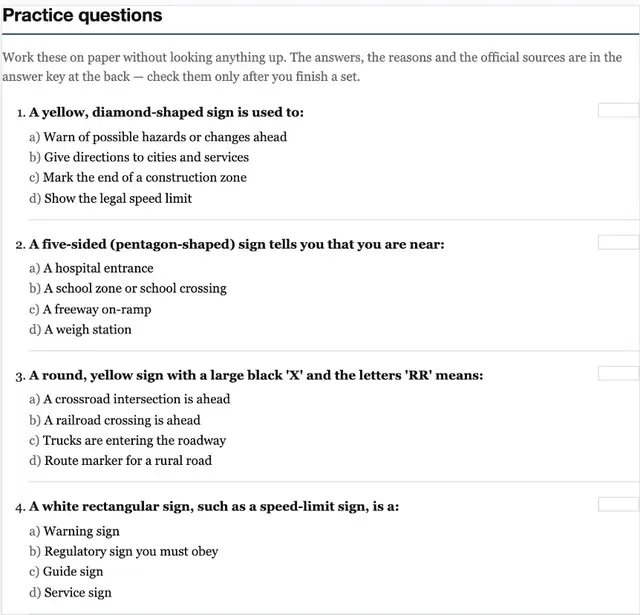
Study offline
California Practice Test Pack — 2026 Printable Edition
$4.99 · One-time purchase. Instant download.
Our own printable edition — nobody paid us to show it to you, and everything in it is free to read here too.
Study questions with answers
12 sample Right-of-Way questions with the correct answer, a short explanation, and the official handbook reference. Read through them, then take the quiz above.
Show all 12 questions with answers
1. Two vehicles reach an intersection at the same time with no signals or signs. Who has the right-of-way?
Correct answer: The vehicle on the right
Where an intersection has no STOP or YIELD signs, whoever arrives first goes first. When you arrive at the same time as another vehicle, give the right-of-way to the one on your right. As a rider, never assume others will yield to you.
2. You are riding past parked cars when a driver in one of them starts to pull away from the curb. What should you do?
Correct answer: Slow down or change lanes so the driver has room to join traffic
A driver leaving a curb may pull out without ever seeing you, so give way by slowing or moving over rather than gambling that they checked for traffic behind them.
Source: California Motorcycle Handbook — Passing Parked Vehicles
3. You have stopped at a stop line where buildings hide the cross traffic. What should you do next?
Correct answer: Creep ahead and stop again just short of the crossing lane, front wheel still clear of it
At a blind intersection you stop at the line, then creep ahead for a second stop just short of the crossing lane and lean forward to look past whatever blocks your view, keeping your front tire out of the path of cross traffic.
Source: California Motorcycle Handbook — Blind Intersections
4. When you make a left turn, who must you yield to?
Correct answer: Oncoming traffic and pedestrians in your path
Before turning left, check for pedestrians. Yield to them and to any oncoming vehicle near enough to be a hazard, and start the turn only when it is safe.
5. A car is coming down an entrance ramp beside you and no other lane is open. What should you do?
Correct answer: Adjust your speed to open a gap and stay near the middle of your lane
Drivers joining from a ramp often never see a motorcycle. When you cannot move over, open a gap by easing off or speeding up, and hold a position near the middle of your lane.
6. You have entered an intersection where a car is waiting to turn. What is the safest thing to do?
Correct answer: Ease away from the turning vehicle without any abrupt change of speed or position
Move clear of vehicles set up to turn, but do it smoothly. A sharp change of pace or lane position can read to the other driver as a sign that you intend to turn.
7. You see a car waiting to pull out from a side street ahead. What is the safest response?
Correct answer: Slow down, cover the brakes, and be ready to stop or change position
Slow down, cover the brakes, and be ready to stop or change position. Never assume the driver sees you; prepare in case the car pulls out.
8. As you near a blind intersection, which lane position should you pick?
Correct answer: The one that brings you into the cross-street driver's view at the earliest moment
Choose the part of the lane that lets a driver on the cross street spot you soonest. Often that means moving away from the parked cars or other objects that are hiding you.
Source: California Motorcycle Handbook — Blind Intersections
9. Where do most collisions between cars and motorcycles happen?
Correct answer: At intersections, often when a car turns left across the rider's path
Most car-motorcycle crashes happen at intersections, often when a car turns left across the rider's path. Slow down and be ready to react as you approach one.
10. According to the handbook, which of these counts as an intersection for a rider?
Correct answer: Any spot where traffic can cross your path, a residential driveway included
An intersection is any place another vehicle may cross in front of you. A downtown crossroad and a driveway on a quiet street both qualify, and both deserve the same searching.
11. The California Driver Handbook describes 'vulnerable road users.' What does this mean for a motorcyclist?
Correct answer: Riders must watch out for cyclists and pedestrians, who are vulnerable road users
The California Driver Handbook defines vulnerable road users as non-motorized road users, such as pedestrians, cyclists, and people using wheelchairs. Pedestrians have the right-of-way, so watch for them and give cyclists enough room.
12. Which move by a driver ahead of you is the most dangerous for a rider?
Correct answer: Making an abrupt U-turn that blocks the entire road
An unexpected U-turn can close off the whole roadway and leave you nowhere to escape. Because you cannot predict it, slow down, use the horn to get the driver's attention, and go by with care.
Source: California Motorcycle Handbook — Passing Parked Vehicles
More Motorcycle topics
Practice Right-of-Way in another state
Every California question is written from the official California driver handbook and checked against its current edition. DMV Test Free is a free, independent study resource — not affiliated with any DMV or government agency. About DMV Test Free
Study offline
California Practice Test Pack — 2026 Printable Edition
$4.99 · One-time purchase. Instant download.
Our own printable edition — nobody paid us to show it to you, and everything in it is free to read here too.