California Motorcycle practice
California Motorcycle: Traffic Laws & Signals practice test
Speed limits, turning and signaling rules, headlight and seat-belt requirements, and the everyday laws every driver must follow.
Content reviewed against official driver handbooks · August 12, 2026
15 questions · pass with 12 correct. You get instant feedback and an explanation after every answer.
Choose your level
Up to 20 questions on this topic, with feedback after every answer.
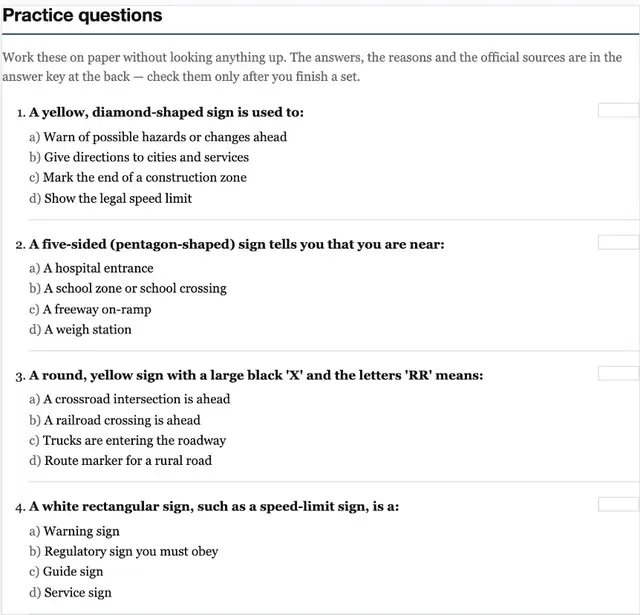
Study offline
California Practice Test Pack — 2026 Printable Edition
$4.99 · One-time purchase. Instant download.
Our own printable edition — nobody paid us to show it to you, and everything in it is free to read here too.
Study questions with answers
12 sample Traffic Laws & Signals questions with the correct answer, a short explanation, and the official handbook reference. Read through them, then take the quiz above.
Show all 12 questions with answers
1. In California, what must an applicant under 21 do before getting a motorcycle license?
Correct answer: Complete an approved motorcyclist safety course and hold a permit for the required time
Applicants under 21 must complete an approved motorcyclist safety training course and hold the instruction permit for the required period before taking the license test.
Source: California Motorcycle Handbook — Licensing Requirements for Riders Under 21
2. In California, what rules apply to a motorcycle that is pulling a trailer?
Correct answer: It must stay out of carpool lanes and may not go faster than 55 mph
A motorcycle towing a trailer is capped at 55 mph, is barred from carpool lanes, and is held to the right lane — the right two lanes on a four-lane highway — except while passing.
Source: California Motorcycle Handbook — Motorcycles Towing Trailers
3. What does California law say about using a cell phone while riding a motorcycle?
Correct answer: You may not hold a phone; it must be used hands-free
California law makes it illegal to drive while using a handheld cell phone. Adults should use a phone only in hands-free mode, and only when necessary; a mounted phone may be worked with a single swipe or touch. Minors may not use a phone to talk or text while driving, except to call for emergency help.
Source: California Driver Handbook — Distracted Driving / Cell Phone Laws
4. Under California's helmet law, who must wear a DOT-compliant helmet on a motorcycle?
Correct answer: All riders and all passengers, regardless of age
California has a universal helmet law: all riders and all passengers must wear a helmet that meets U.S. DOT safety standards, no matter their age.
Source: California Motorcycle Handbook — California Helmet Law
5. Why is distracted riding dangerous on a motorcycle?
Correct answer: Riding is a demanding task that needs your full attention, so any distraction is risky
The handbook calls riding a motorcycle a demanding and complex task. Skilled riders keep their attention on the riding environment, spotting hazards, making good judgments, and acting quickly, so even a brief distraction can cost you.
Source: California Motorcycle Handbook — Being in Shape to Ride
6. Under California's Move Over and Slow Down law, you must move over and slow down for:
Correct answer: A stationary emergency vehicle or tow truck with flashing warning lights
The California Driver Handbook says to move over and slow down for stationary emergency vehicles and tow trucks showing flashing amber warning lights, and for stopped road work vehicles with flashing or amber warning lights. The rule covers far more than police cars.
Source: California Driver Handbook — Move Over, Slow Down Law
7. What does California require in order to ride a motorcycle on public roads?
Correct answer: A Class M1 motorcycle license or, to practice, a Class M1 instruction permit
You need a Class M1 motorcycle license, or a Class M1 instruction permit while you practice. A regular Class C car license alone does not allow you to ride a motorcycle.
Source: California Motorcycle Handbook — Motorcycle Licensing
8. May a motorcyclist ride in a California carpool (HOV) lane?
Correct answer: Yes, unless signs posted for that lane say otherwise
Carpool or HOV lanes are open to motorcycles unless a posted sign says otherwise. Riders should still enter and leave only at the designated openings instead of crossing the double parallel lines.
Source: California Motorcycle Handbook — Carpool/High-Occupancy Vehicle (HOV) Lanes
9. How should a motorcycle usually be parked at a curb in California?
Correct answer: At an angle with a wheel or the fender touching the curb
Park at an angle to the curb with at least one wheel or the fender touching it, unless local rules say otherwise. This keeps the bike from sticking out into traffic.
Source: California Motorcycle Handbook — Parking at the Curb
10. What is required before you can legally carry a passenger on your motorcycle?
Correct answer: The motorcycle must have a passenger seat and footrests for the passenger
The motorcycle must have a passenger seat and footrests for the passenger. Only carry a passenger if the bike is designed and equipped to do so.
Source: California Motorcycle Handbook — Carrying Passengers
11. While riding on a California motorcycle instruction permit, you may NOT:
Correct answer: Carry passengers, ride on freeways, or ride in darkness
A motorcycle instruction permit lets you practice but has limits: you may not carry passengers, ride on the freeway, or ride in darkness. These rules help new riders build skill safely.
Source: California Motorcycle Handbook — Motorcycle Instruction Permit
12. What does California law say about lane splitting (riding between rows of stopped or slow traffic)?
Correct answer: It is legal in California
The California Driver Handbook says motorcycles may legally share a lane with other vehicles, which is known as lane splitting. Other rules still apply: under the Basic Speed Law, you may never ride faster than is safe for current conditions.
Source: California Driver Handbook — Sharing the Road with Motorcyclists
More Motorcycle topics
Practice Traffic Laws & Signals in another state
Every California question is written from the official California driver handbook and checked against its current edition. DMV Test Free is a free, independent study resource — not affiliated with any DMV or government agency. About DMV Test Free
Study offline
California Practice Test Pack — 2026 Printable Edition
$4.99 · One-time purchase. Instant download.
Our own printable edition — nobody paid us to show it to you, and everything in it is free to read here too.