Free Delaware DMV Car / Permit Practice Test 2026
The Delaware Car / Permit knowledge test has 32 questions, and you need 26 correct (81%) to pass. Practice free with questions written from the official Delaware driver handbook — every one has a clear explanation, and you can retake as often as you like with no sign-up.
Content reviewed against official driver handbooks · August 12, 2026
What's on the Delaware written test
The Delaware Car / Permit knowledge test has 32 questions; you need 26 correct (81%) to pass.
Based on the official Delaware exam format — always confirm current details with your state DMV.
Practice by topic
Focus on one area at a time — each topic has its own set of Delaware practice questions.
Learn the shapes, colors, and meanings of regulatory, warning, and guide signs — from stop and yield to construction and school-zone signs.
Speed limits, turning and signaling rules, headlight and seat-belt requirements, and the everyday laws every driver must follow.
How to read traffic signals, lane lines, and pavement markings — including yellow and white lines, arrows, and flashing lights.
Who goes first at intersections, four-way stops, roundabouts, and crosswalks, and how to yield to pedestrians and emergency vehicles.
Following distance, scanning, blind spots, using your lights, and the habits that prevent crashes and keep you in control.
Driving safely around motorcycles, bicycles, large trucks, pedestrians, and school buses — and knowing who has the right of way.
Blood alcohol limits, zero-tolerance and implied-consent laws, and how alcohol and drugs — legal or not — affect your driving.
Legal and illegal parking, colored curbs, distances from hydrants and crossings, and how to park safely on hills.
Choosing a safe speed, keeping a space cushion, adjusting for weather and traffic, and understanding stopping distance.
What to do when things go wrong — brake failure, tire blowouts, skids, and stalling on railroad tracks.
The point system, license suspension, provisional-license rules, insurance requirements, and other licensing basics.
How to pass the first time
- Read the official Delaware driver handbook at least once before test day.
- Practice by topic to find your weak spots, then fix them.
- Take full-length practice tests until you pass comfortably every time.
- Read every explanation — understanding beats memorizing.
Delaware Car / Permit test — frequently asked questions
How many questions are on the Delaware Car / Permit test?
The Delaware Car / Permit knowledge test has 32 questions, and you need 26 correct (81%) to pass. Our practice tests mirror that format.
How many questions can I miss on the Delaware Car / Permit test?
You can miss up to 6 of the 32 questions and still pass — you need 26 correct, which is 81%.
Can I retake the practice test?
Yes — practice as often as you like, completely free. The questions and answer choices are shuffled each time.
Can I take the Delaware practice test in Spanish?
Yes. Every question here is available in English and Spanish — switch languages anytime. Many states also offer the real knowledge test in languages other than English; confirm what Delaware offers with your DMV.
Can I practice on my phone?
Yes. The practice tests work in any mobile or desktop browser — no app or sign-up needed — so you can study anywhere.
Are these the real DMV test questions?
No. Our questions are original, written from the current official Delaware driver handbook to match the real test's topics and style. We are not affiliated with any DMV or government agency.
What's the best way to study?
Read the Delaware driver handbook, practice by topic to target weak areas, and finish with full-length tests until you consistently pass.
Other Delaware practice tests
Take the Car / Permit test in another state
Every Delaware question is written from the official Delaware driver handbook and checked against its current edition. DMV Test Free is a free, independent study resource — not affiliated with any DMV or government agency. About DMV Test Free
Delaware Car / Permit questions with answers
20 sample questions from the Delaware Car / Permit question bank — each with the correct answer, a short explanation, and the section of the official handbook it comes from.
Show all 20 questions with answers
1. A Delaware crash on a public highway must be reported to police once property damage appears to reach what figure?
Correct answer: $500 or more
Any injury or death must be reported whatever the damage. On a public highway apparent damage of five hundred dollars also requires a report, and the threshold is a thousand where impairment seems to be involved.
Source: Delaware Driver Manual — Reporting Crashes
2. How long is the temporary license an officer issues after a Delaware impaired-driving arrest?
Correct answer: 15 days
The officer keeps the license and hands over a fifteen day temporary. That is the window in which to request an administrative hearing, and without one the revocation begins when it runs out.
Source: Delaware Driver Manual — Delaware Specific Penalties And Procedures
3. What do the alternately flashing yellow lights on a Delaware school bus tell you?
Correct answer: The bus is about to stop for children, so slow down and get ready
The amber pair comes on about ten seconds before the red lights to warn that a stop for loading or unloading is coming. Expect children waiting nearby or hurrying to board.
Source: Delaware Driver Manual — Stopping For School Buses
4. Which hand position on the steering wheel does the Delaware manual recommend?
Correct answer: One hand between 8 and 10 o'clock and the other between 2 and 4 o'clock
Placing your hands on opposite sides of the wheel is comfortable and lets you steer through turns at highway speed without lifting either hand away.
Source: Delaware Driver Manual — Steering
5. Which driver mistake accounts for a large share of injury crashes between cars and motorcycles?
Correct answer: Turning left across the path of an oncoming rider
Drivers either fail to pick the rider out of the traffic scene or misjudge how fast the machine is closing, which is why the manual says to look, then look again, before turning left.
Source: Delaware Driver Manual — Sharing The Road With Motorcycles
6. What fee does Delaware charge to reinstate a revoked driver license?
Correct answer: $200
Reinstating a suspended license costs fifty dollars while a revoked one costs two hundred, and the Division may require the knowledge, road and eye examinations to be taken again.
Source: Delaware Driver Manual — License Revocation And Suspension
7. You have to park on the shoulder of a highway after dark. What does Delaware require?
Correct answer: Switch on the parking lights, or the four-way flashers where the vehicle has them
Between sunset and sunrise, or whenever people and objects cannot be made out a thousand feet away, a vehicle left at the roadside must show parking lights or hazard flashers. Flashing a signal on one side alone is not permitted.
Source: Delaware Driver Manual — General Parking Rules
8. During which period of the year are studded tires legal in Delaware?
Correct answer: From October 15 through April 15
Delaware allows studded tires between those dates and forbids them for the rest of the year. Other states set their own windows, and their rules govern while you are passing through.
Source: Delaware Driver Manual — Prohibited Equipment
9. At 55 mph, how large a gap in oncoming traffic does the Delaware manual say a pass requires?
Correct answer: About ten seconds, which is roughly a third of a mile of clear road
In ten seconds you and an approaching vehicle each cover more than eight hundred feet, so a safe pass needs over sixteen hundred feet of sight distance.
Source: Delaware Driver Manual — Space To Pass
10. The white X-shaped crossbuck at a Delaware rail crossing carries the same legal weight as which sign?
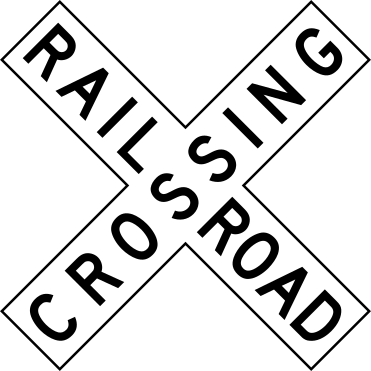
Correct answer: A yield sign
Delaware treats the crossbuck exactly the way it treats a yield sign. Any train that is crossing has priority and the driver must give way to it.
Source: Delaware Driver Manual — Highway-Rail Intersection Signs And Signals
11. Every light at an intersection is dark because of a power cut. What does Delaware require of you?
Correct answer: Slow down and be ready to give way to vehicles in or nearing the intersection
Where signals are in place but no lighted indication can be seen, an approaching driver has to cut speed and prepare to yield to other traffic there.
Source: Delaware Driver Manual — Understanding Traffic Signals
12. Your brake pedal sinks to the floor while you are driving. What does the manual say to try first?
Correct answer: Pump the pedal several times to build pressure back up
Pumping often restores enough pressure to stop the vehicle. If it does not, ease the parking brake on gradually, then shift down and look for a safe place off the road to come to rest.
Source: Delaware Driver Manual — Brake Failure
13. What does the Delaware manual say about medicines bought without a prescription?
Correct answer: They can impair driving, so read the label and ask a doctor or pharmacist when unsure
Remedies for colds, headaches and allergies can bring on drowsiness, and pep pills leave a driver jittery, dizzy and unfocused once they wear off. None of them should ever be mixed with alcohol.
Source: Delaware Driver Manual — Drugs Combined With Alcohol
14. Once you are circulating inside a roundabout, what does the Delaware manual say about stopping?
Correct answer: Do not stop unless it is needed to avoid a collision, because you have priority over entering vehicles
Traffic already going around holds priority over vehicles waiting to enter, so keep moving slowly counterclockwise, stay right of the central island, do not pass, and halt only to prevent a crash.
Source: Delaware Driver Manual — How to Use a Roundabout
15. What does the Delaware manual advise an angry driver to do?
Correct answer: Take time to cool off and stay off the road until calm
Strong feelings such as anger, fear, worry or excitement interfere with driving. The manual suggests waiting, even taking a short walk, until you have settled down.
Source: Delaware Driver Manual — Emotions
16. When may a Delaware driver sound the horn at a bicyclist?
Correct answer: Only to warn of a collision that is about to happen
Honking at riders is forbidden apart from the narrow case of warning them about imminent danger.
Source: Delaware Driver Manual — Bicycle Friendly Delaware Act
17. At how many calculated points does the Division send a Delaware driver an advisory letter?
Correct answer: 8
Eight calculated points brings the advisory letter. Twelve requires a behavior modification course, and fourteen means a mandatory four-month suspension.
Source: Delaware Driver Manual — Driver Improvement Problem Driver Program Actions
18. What does Delaware law say about opening a car door into the street?
Correct answer: You may not open it so as to block traffic or endanger anyone, so use the curb-side door where you can
Before using the street-side door, turn and check for anything coming, and watch especially for cyclists, who can be badly hurt striking an opened door.
Source: Delaware Driver Manual — General Parking Rules
19. How is Delaware's occupant restraint requirement enforced?
Correct answer: An officer may stop the vehicle solely because someone inside is unbuckled, and the driver gets the ticket
Everyone in the vehicle must be properly restrained by a belt or a child seat. Seeing an unrestrained occupant is by itself grounds for a stop, and the citation goes to the driver.
Source: Delaware Driver Manual — Using Safety Belts And Child Restraints
20. How near a hill or curve should you avoid beginning a pass?
Correct answer: Within about one-third of a mile of it
A blind rise or bend may be hiding an approaching vehicle, so treat it exactly as though one were there and do not start the maneuver within roughly a third of a mile.
Source: Delaware Driver Manual — Space To Pass