Free California DMV CDL — Air Brakes Practice Test 2026
The California CDL — Air Brakes knowledge test has ~25 questions, and you need ~20 correct (80%) to pass. Practice free with questions written from the official California driver handbook — every one has a clear explanation, and you can retake as often as you like with no sign-up.
Content reviewed against official driver handbooks · August 12, 2026
What's on the California written test
The California CDL — Air Brakes knowledge test has ~25 questions; you need ~20 correct (80%) to pass.
Based on the official California exam format — always confirm current details with your state DMV.
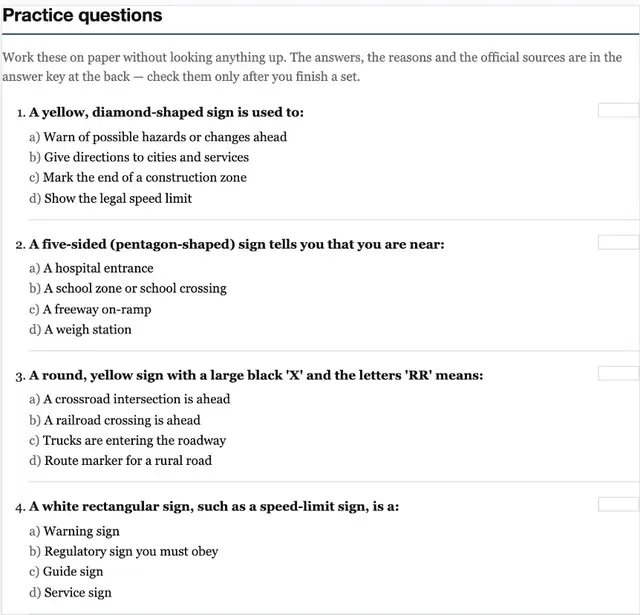
Prefer to study on paper?
We make and sell this edition ourselves — it is our own product, not a partner's, and nobody paid us to show it to you. Everything inside it is also free to read on this site; what you are buying is the printable format.
Study offline
California Practice Test Pack — 2026 Printable Edition
All 492 California practice questions with worked explanations and answer keys — car, motorcycle, CDL and air brakes, in English and Spanish. Eight print-ready PDFs, 664 pages; the car and CDL editions add 146 cut-out road-sign flashcards.
Get the printable edition — $4.99- One-time purchase
- Instant download
- 14-day refund
Practice by topic
Focus on one area at a time — each topic has its own set of California practice questions.
Following distance, scanning, blind spots, using your lights, and the habits that prevent crashes and keep you in control.
Choosing a safe speed, keeping a space cushion, adjusting for weather and traffic, and understanding stopping distance.
What to do when things go wrong — brake failure, tire blowouts, skids, and stalling on railroad tracks.
How to pass the first time
- Read the official California driver handbook at least once before test day.
- Practice by topic to find your weak spots, then fix them.
- Take full-length practice tests until you pass comfortably every time.
- Read every explanation — understanding beats memorizing.
California CDL — Air Brakes test — frequently asked questions
How many questions are on the California CDL — Air Brakes test?
The California CDL — Air Brakes knowledge test has ~25 questions, and you need ~20 correct (80%) to pass. Our practice tests mirror that format.
How many questions can I miss on the California CDL — Air Brakes test?
You can miss up to ~5 of the ~25 questions and still pass — you need ~20 correct, which is 80%.
Can I retake the practice test?
Yes — practice as often as you like, completely free. The questions and answer choices are shuffled each time.
Can I take the California practice test in Spanish?
Yes. Every question here is available in English and Spanish — switch languages anytime. Many states also offer the real knowledge test in languages other than English; confirm what California offers with your DMV.
Can I practice on my phone?
Yes. The practice tests work in any mobile or desktop browser — no app or sign-up needed — so you can study anywhere.
Are these the real DMV test questions?
No. Our questions are original, written from the current official California driver handbook to match the real test's topics and style. We are not affiliated with any DMV or government agency.
What's the best way to study?
Read the California driver handbook, practice by topic to target weak areas, and finish with full-length tests until you consistently pass.
Other California practice tests
Take the CDL — Air Brakes test in another state
Every California question is written from the official California driver handbook and checked against its current edition. DMV Test Free is a free, independent study resource — not affiliated with any DMV or government agency. About DMV Test Free
California CDL — Air Brakes questions with answers
20 sample questions from the California CDL — Air Brakes question bank — each with the correct answer, a short explanation, and the section of the official handbook it comes from.
Show all 20 questions with answers
1. For an average driver with good traction and brakes, about how far does a vehicle with air brakes need to stop from 55 mph?
Correct answer: Over 450 feet
With air brakes, total stopping distance adds brake lag to perception, reaction, and braking distance. At 55 mph on dry pavement, brake lag alone adds about 32 feet, so an average driver with good traction and brakes needs over 450 feet to stop.
2. Why is it a bad habit to press and release the brake pedal over and over when you do not need to?
Correct answer: Each release vents air, and you can use it up faster than the compressor refills the tanks
Every time the brakes are released, some compressed air leaves the system and tank pressure drops. Needless pedal work can drain air quicker than the compressor makes it up, and brakes without enough pressure do not work.
3. You must make a quick emergency stop in a vehicle without anti-lock brakes. Which describes the stab braking method?
Correct answer: Apply the brakes fully, release when the wheels lock, and reapply when they start rolling again
In stab braking, you apply the brakes all the way, release when the wheels lock up, and reapply fully as soon as the wheels start rolling again. This keeps the vehicle in a straight line while stopping quickly.
4. On heavy trucks and buses, the parking and emergency brakes are held on by mechanical force — usually springs — rather than by air. Why?
Correct answer: Air pressure can leak away over time
Air can eventually leak out of the system, so brakes held on by air alone would let go. Springs hold the brakes on mechanically, and air pressure is used to keep those springs back while the vehicle is driven.
5. In which situation should you NOT use the parking brakes when parking?
Correct answer: When the brakes are very hot or very wet in freezing temperatures
Do not use the parking brakes if the brakes are very hot (such as just after a steep downgrade) or if the brakes are very wet in freezing temperatures. Hot brakes can be damaged and wet brakes can freeze to the drums; let hot brakes cool, or drive lightly in low gear to warm and dry wet brakes.
6. What must a driver do to hold a CDL without an air brake restriction?
Correct answer: Pass the air brakes knowledge test and take the skills test in a vehicle with full air brakes
You must pass the air brakes knowledge test and take your skills test in a vehicle equipped with a full air brake system. Failing the air brakes knowledge test, or testing in a vehicle without air brakes, results in an air brake restriction.
7. How should you use the brake pedal to make a normal stop in a vehicle with air brakes?
Correct answer: Push it down steadily and smoothly until the vehicle stops
Push the brake pedal down steadily and smoothly. Control the pressure so the vehicle comes to a smooth, safe stop; with a manual transmission, don't push the clutch in until engine rpm is close to idle.
8. You test air leakage on a single vehicle by turning off the engine, releasing the service brake, and timing the pressure drop. What is the maximum acceptable leakage rate with the brakes released?
Correct answer: Less than 2 psi in one minute
With the engine off and brakes released, air loss for a single vehicle should be less than 2 psi in one minute (less than 3 psi per minute for a combination vehicle). Faster loss means an air leak that must be fixed before driving.
9. Your service brakes stop working on a mountain downgrade because they have overheated and faded. What is your best option?
Correct answer: Use an escape ramp if one is available
Use an escape ramp if one is available. Escape ramps are built on many steep grades to safely stop runaway vehicles using a long bed of loose material or an upgrade, and using one avoids a far worse crash.
10. It is freezing outside and your brakes are very wet. Before you park, what does the handbook suggest doing about the wet brakes?
Correct answer: Drag the brakes gently in a low gear so the heat dries them out
If the parking brakes are set while soaked brakes sit in freezing weather, they can freeze and leave the vehicle unable to move. Light braking in a low gear warms the brakes and dries them first.
11. You must leave a vehicle that is not equipped with spring brakes parked and unattended. What must you do to keep it from moving?
Correct answer: Use wheel chocks to keep the vehicle from moving
If the vehicle does not have spring brakes, air pressure can leak off and release the brakes, so you must use wheel chocks to hold the vehicle. Never leave such a vehicle relying on air pressure alone.
12. Who needs to study the Air Brakes section and pass the air brakes knowledge test in California?
Correct answer: Any driver who wants to operate a vehicle equipped with air brakes, regardless of class
Any driver who wants to operate a vehicle equipped with air brakes — whether it requires a Class A, Class B, or Class C commercial license — must know the air brakes material and pass the air brakes knowledge test to avoid the restriction.
13. With air brakes, how long does it take after you push the brake pedal for air to reach the brakes through the lines?
Correct answer: 1/2 second or more
Section 5.4.4 calls this delay brake lag. Hydraulic brakes work instantly, but air brakes need a moment, 1/2 second or more, while the air travels through the lines. At 55 mph on dry pavement, brake lag adds about 32 feet to your stop.
14. Your vehicle has automatic slack adjusters, and you find a brake that is out of adjustment. What does the handbook recommend?
Correct answer: Get it to a repair shop promptly, because a mechanical problem is likely
With automatic adjusters, an out-of-adjustment brake points to a fault in the adjuster, in the related foundation brake parts, or in how the adjuster was installed. Adjusting it by hand usually hides that fault instead of curing it, so manual adjustment is only a stopgap for an emergency.
15. What is "controlled braking" in an emergency stop?
Correct answer: Braking as hard as possible without locking the wheels
Controlled braking means applying the brakes as hard as you can without locking the wheels. Keep steering movements very small while braking this way; if you need to make larger steering adjustments or the wheels lock, release the brakes, then reapply.
16. Your spring brakes are applied. Why should you avoid pushing down on the brake pedal?
Correct answer: Spring force and air pressure together could damage the brakes
With the spring brakes on, pressing the pedal adds air pressure on top of the spring force, and the two together can damage the brakes. Many systems are built to prevent this, but not all are, so make it a habit never to do it.
17. During your pre-trip inspection you find the air leakage rate is above the allowed maximum. What are you required to do?
Correct answer: Fix the leak before driving — operating with defective air brakes is not allowed
If air is leaking faster than the allowed rate (for example, more than 2 psi per minute with engine off and brakes released on a single vehicle), the leak must be found and fixed before you drive. Driving with defective air brakes can put the vehicle out of service and is dangerous and illegal.
18. Your CDL skills test vehicle has air-over-hydraulic brakes instead of a full air brake system. What restriction will be placed on your CDL?
Correct answer: A restriction against driving vehicles equipped with a full air brake system
If you take the skills test in a vehicle with air-over-hydraulic brakes, your CDL is restricted from any vehicle whose brakes operate fully on the air brake principle. A road test is required to remove a restriction based on vehicle equipment.
19. How do brakes that are out of adjustment contribute to brake fade on the rest of the vehicle?
Correct answer: They stop doing their share of the work, so the other brakes overheat
Every brake has to carry part of the load. A brake that is out of adjustment quits contributing first, the remaining brakes take on extra work and heat up, and there may not be enough braking left to keep the vehicle under control. Brakes can go out of adjustment quickly when hot, so check them often.
20. In the applied leakage test, you shut off the engine, release the parking brake, and hold the foot brake fully down for one minute. On a single vehicle, what is the most the air pressure may drop?
Correct answer: 3 psi
With the brakes fully applied, a single vehicle may lose no more than 3 psi in one minute. The limit is 4 psi for a combination of two vehicles and 6 psi for three or more. A bigger loss means repairs are needed before the vehicle is driven.