Free Illinois DMV Motorcycle Practice Test 2026
The Illinois Motorcycle knowledge test has ~15 questions, and you need ~12 correct (~80%) to pass. Practice free with questions written from the official Illinois driver handbook — every one has a clear explanation, and you can retake as often as you like with no sign-up.
Content reviewed against official driver handbooks · August 12, 2026
What's on the Illinois written test
The Illinois Motorcycle knowledge test has ~15 questions; you need ~12 correct (~80%) to pass.
Based on the official Illinois exam format — always confirm current details with your state DMV.
Practice by topic
Focus on one area at a time — each topic has its own set of Illinois practice questions.
Helmets, eye protection, and abrasion-resistant gear — what the motorcycle handbook requires and why each piece matters in a crash.
Throttle, clutch, both brakes, and shifting — the controls you must operate smoothly before the road test.
Countersteering, the slow-look-press-roll technique, and choosing the right line through a curve at motorcycle speeds.
Using both brakes together, stopping quickly without locking a wheel, and recovering from a skid.
Where to position yourself in the lane to be seen, managing blind spots, and sharing the road safely with cars and trucks.
Conspicuity — reflective and bright clothing, headlight use, and lane position that make a rider easier for drivers to see.
Gravel, wet pavement, grooved roads, and railroad tracks — reading and handling surfaces that matter far more on two wheels.
Learn the shapes, colors, and meanings of regulatory, warning, and guide signs — from stop and yield to construction and school-zone signs.
Speed limits, turning and signaling rules, headlight and seat-belt requirements, and the everyday laws every driver must follow.
Who goes first at intersections, four-way stops, roundabouts, and crosswalks, and how to yield to pedestrians and emergency vehicles.
Blood alcohol limits, zero-tolerance and implied-consent laws, and how alcohol and drugs — legal or not — affect your driving.
How to read traffic signals, lane lines, and pavement markings — including yellow and white lines, arrows, and flashing lights.
Following distance, scanning, blind spots, using your lights, and the habits that prevent crashes and keep you in control.
Driving safely around motorcycles, bicycles, large trucks, pedestrians, and school buses — and knowing who has the right of way.
Legal and illegal parking, colored curbs, distances from hydrants and crossings, and how to park safely on hills.
Choosing a safe speed, keeping a space cushion, adjusting for weather and traffic, and understanding stopping distance.
What to do when things go wrong — brake failure, tire blowouts, skids, and stalling on railroad tracks.
The point system, license suspension, provisional-license rules, insurance requirements, and other licensing basics.
How to pass the first time
- Read the official Illinois driver handbook at least once before test day.
- Practice by topic to find your weak spots, then fix them.
- Take full-length practice tests until you pass comfortably every time.
- Read every explanation — understanding beats memorizing.
Illinois Motorcycle test — frequently asked questions
How many questions are on the Illinois Motorcycle test?
The Illinois Motorcycle knowledge test has ~15 questions, and you need ~12 correct (~80%) to pass. Our practice tests mirror that format.
How many questions can I miss on the Illinois Motorcycle test?
You can miss up to ~3 of the ~15 questions and still pass — you need ~12 correct, which is ~80%.
Can I retake the practice test?
Yes — practice as often as you like, completely free. The questions and answer choices are shuffled each time.
Can I take the Illinois practice test in Spanish?
Yes. Every question here is available in English and Spanish — switch languages anytime. Many states also offer the real knowledge test in languages other than English; confirm what Illinois offers with your DMV.
Can I practice on my phone?
Yes. The practice tests work in any mobile or desktop browser — no app or sign-up needed — so you can study anywhere.
Are these the real DMV test questions?
No. Our questions are original, written from the current official Illinois driver handbook to match the real test's topics and style. We are not affiliated with any DMV or government agency.
What's the best way to study?
Read the Illinois driver handbook, practice by topic to target weak areas, and finish with full-length tests until you consistently pass.
Other Illinois practice tests
Take the Motorcycle test in another state
Every Illinois question is written from the official Illinois driver handbook and checked against its current edition. DMV Test Free is a free, independent study resource — not affiliated with any DMV or government agency. About DMV Test Free
Illinois Motorcycle questions with answers
20 sample questions from the Illinois Motorcycle question bank — each with the correct answer, a short explanation, and the section of the official handbook it comes from.
Show all 20 questions with answers
1. What kind of footwear does the manual recommend for riding?
Correct answer: Sturdy boots that cover the ankles with slip-resistant soles
Boots or shoes should be tall and sturdy enough to cover and support the ankles, with hard, slip-resistant soles and short heels, and laces tucked in.
Source: Illinois Motorcycle Operator Manual — Clothing
2. Why do drivers so often fail to notice an approaching motorcycle?
Correct answer: Its small outline is easy to overlook, and drivers aren't looking for it
Seen head-on or from the rear, a bike presents a far thinner shape than a car, and drivers generally aren't watching for two-wheelers at all.
Source: Illinois Motorcycle Operator Manual — Being Seen
3. If no traffic is present, what is a good cornering line through a curve?
Correct answer: Start outside, move to the inside, then exit to the outside
With no traffic, start at the outside of the curve to widen your line of sight, move toward the inside as you turn, then move to the outside to exit.
Source: Illinois Motorcycle Operator Manual — Cornering
4. A WRONG WAY sign is facing you as you ride. What is it telling you?
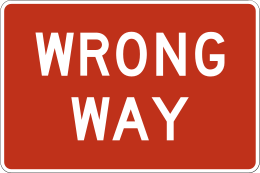
Correct answer: You are traveling against the flow of traffic and must not continue
The sign turns up on ramps just past DO NOT ENTER, and also where a rider has turned against traffic onto a one-way street, into an alley, or into a driveway; you are going the wrong way and must not continue.
Source: Illinois Rules of the Road — Regulatory Signs (Wrong Way)
5. How must a vehicle sit when parallel parked on a two-way street in Illinois?
Correct answer: Within 12 inches of the curb, facing the direction traffic travels
The right-hand wheels belong within a foot of the curb, running parallel with it, and the vehicle must face the way traffic moves.
Source: Illinois Rules of the Road — Parallel Parking
6. What is a limitation of convex (rounded) mirrors on some motorcycles?
Correct answer: They make vehicles look farther away than they are
Convex mirrors widen your view but make following traffic look more distant than it truly is, so leave extra room before you change lanes.
Source: Illinois Motorcycle Operator Manual — Using Your Mirrors
7. Why should group riders never ride directly alongside one another?
Correct answer: It leaves no room to escape a hazard
Riding directly beside another rider leaves you no place to go if you must avoid a car or something in the road; wait until you are stopped to talk.
Source: Illinois Motorcycle Operator Manual — Group Riding
8. What mistakes do most crash-involved riders make with braking and swerving?
Correct answer: They under-brake the front, over-brake the rear, and mix braking with swerving
Research finds that riders in crashes tend to brake the front too little and the rear too much, and they fail to keep braking apart from swerving.
Source: Illinois Motorcycle Operator Manual — Crash Avoidance
9. To carry out a decision in SIPDE and create more space, what can you do?
Correct answer: Communicate, adjust your speed, and change position or direction
Execute by communicating with lights or horn, adjusting your speed, and changing your position or direction to reduce the hazard.
Source: Illinois Motorcycle Operator Manual — SIPDE
10. In traffic, how does the room a motorcycle needs to stop compare with a car's?
Correct answer: A motorcycle needs about as much room as a car
A motorcycle is not able to stop in noticeably less room; it needs about as much distance as a car, which is why the following gap matters.
Source: Illinois Motorcycle Operator Manual — Following Another Vehicle
11. Before riding an unfamiliar motorcycle, what should you do?
Correct answer: Find the key controls, learn the gear pattern, and ride cautiously at first
Locate the turn signals, horn, headlight switch, fuel valve, and engine cut-off, learn the gear pattern, and ride cautiously with gentle acceleration and extra stopping room.
Source: Illinois Motorcycle Operator Manual — Get Familiar with the Controls
12. If an animal is in your path while you are riding in traffic, what should you do?
Correct answer: Stay in your lane rather than swerve into traffic
Do all you safely can to avoid an animal, but if you are in traffic, remain in your lane; hitting something small is less dangerous than hitting a car.
Source: Illinois Motorcycle Operator Manual — Animals
13. A moped satisfies all four of the criteria Illinois lists. What license does the operator need?
Correct answer: Any valid Illinois-recognized driver's license, whatever its class
Once all four criteria are met, any current and valid driver's license of any classification is enough; a machine that misses even one becomes a motor-driven cycle needing a Class L.
Source: Illinois Motorcycle Operator Manual — Classification Criteria
14. In a posted school zone, what speed applies and under what conditions?
Correct answer: 20 mph on school days when children are present
The 20 mph school-zone limit is in force on days school operates, from 6:30 in the morning until 4 in the afternoon, whenever children are nearby and the signs are up.
Source: Illinois Rules of the Road — School Zones
15. What is the Illinois rule covering a motorcycle's muffler and exhaust system?
Correct answer: It must be working and maintained at all times, and louder exhausts are illegal
The muffler has to work at all times and be kept up so the bike is not unusually loud, and reworking the exhaust to raise the noise level is against the law.
Source: Illinois Motorcycle Operator Manual — Required Equipment
16. Using hand and arm signals, how do you show that you are slowing or coming to a stop?
Correct answer: Left arm extended and pointed downward
All hand signals are given with the left arm; pointing that arm downward is the sign for slowing or stopping.
Source: Illinois Rules of the Road — Signaling
17. Two vehicles on different roads reach a four-way stop at exactly the same moment. Who goes first?
Correct answer: The vehicle on the right proceeds first
When arrivals are simultaneous, the driver on the left gives way to the one on the right; otherwise, whoever stopped first moves out first.
Source: Illinois Rules of the Road — Right of Way
18. How does the alcohol in a 12-ounce beer compare with that in a 5-ounce glass of wine or in a hard-liquor shot measuring 1.5 ounces?
Correct answer: Each one delivers an equal dose of alcohol
The serving sizes differ, but each of those three drinks delivers an equal dose of alcohol, so switching from liquor to beer or wine does not lower what reaches your bloodstream.
Source: Illinois Motorcycle Operator Manual — Alcohol and Other Drugs
19. How should a rider's jacket and pants fit and what material offers the most protection?
Correct answer: Snug but movable, covering arms and legs, with leather offering the best protection
Riding gear should completely cover the arms and legs and fit snugly enough not to flap yet loose enough to move freely; leather gives the most protection.
Source: Illinois Motorcycle Operator Manual — Clothing
20. Why is a motorcycle's brake light easier to miss than a car's?
Correct answer: It is usually less noticeable, particularly with the taillight on
A motorcycle's brake light is usually less noticeable, especially when the taillight is already on, so flashing it can help others notice you slowing.
Source: Illinois Motorcycle Operator Manual — Brake Light