Free New York DMV CDL — General Knowledge Practice Test 2026
The New York CDL — General Knowledge knowledge test has ~50 questions, and you need ~40 correct (80%) to pass. Practice free with questions written from the official New York driver handbook — every one has a clear explanation, and you can retake as often as you like with no sign-up.
Content reviewed against official driver handbooks · August 12, 2026
What's on the New York written test
The New York CDL — General Knowledge knowledge test has ~50 questions; you need ~40 correct (80%) to pass.
Based on the official New York exam format — always confirm current details with your state DMV.
Practice by topic
Focus on one area at a time — each topic has its own set of New York practice questions.
Learn the shapes, colors, and meanings of regulatory, warning, and guide signs — from stop and yield to construction and school-zone signs.
Speed limits, turning and signaling rules, headlight and seat-belt requirements, and the everyday laws every driver must follow.
How to read traffic signals, lane lines, and pavement markings — including yellow and white lines, arrows, and flashing lights.
Following distance, scanning, blind spots, using your lights, and the habits that prevent crashes and keep you in control.
Driving safely around motorcycles, bicycles, large trucks, pedestrians, and school buses — and knowing who has the right of way.
Blood alcohol limits, zero-tolerance and implied-consent laws, and how alcohol and drugs — legal or not — affect your driving.
Legal and illegal parking, colored curbs, distances from hydrants and crossings, and how to park safely on hills.
Choosing a safe speed, keeping a space cushion, adjusting for weather and traffic, and understanding stopping distance.
What to do when things go wrong — brake failure, tire blowouts, skids, and stalling on railroad tracks.
The point system, license suspension, provisional-license rules, insurance requirements, and other licensing basics.
How to pass the first time
- Read the official New York driver handbook at least once before test day.
- Practice by topic to find your weak spots, then fix them.
- Take full-length practice tests until you pass comfortably every time.
- Read every explanation — understanding beats memorizing.
New York CDL — General Knowledge test — frequently asked questions
How many questions are on the New York CDL — General Knowledge test?
The New York CDL — General Knowledge knowledge test has ~50 questions, and you need ~40 correct (80%) to pass. Our practice tests mirror that format.
How many questions can I miss on the New York CDL — General Knowledge test?
You can miss up to ~10 of the ~50 questions and still pass — you need ~40 correct, which is 80%.
Can I retake the practice test?
Yes — practice as often as you like, completely free. The questions and answer choices are shuffled each time.
Can I take the New York practice test in Spanish?
Yes. Every question here is available in English and Spanish — switch languages anytime. Many states also offer the real knowledge test in languages other than English; confirm what New York offers with your DMV.
Can I practice on my phone?
Yes. The practice tests work in any mobile or desktop browser — no app or sign-up needed — so you can study anywhere.
Are these the real DMV test questions?
No. Our questions are original, written from the current official New York driver handbook to match the real test's topics and style. We are not affiliated with any DMV or government agency.
What's the best way to study?
Read the New York driver handbook, practice by topic to target weak areas, and finish with full-length tests until you consistently pass.
Other New York practice tests
Take the CDL — General Knowledge test in another state
Every New York question is written from the official New York driver handbook and checked against its current edition. DMV Test Free is a free, independent study resource — not affiliated with any DMV or government agency. About DMV Test Free
New York CDL — General Knowledge questions with answers
20 sample questions from the New York CDL — General Knowledge question bank — each with the correct answer, a short explanation, and the section of the official handbook it comes from.
Show all 20 questions with answers
1. A bus driver who must stop at a railroad crossing should bring the bus to a halt:
Correct answer: Between 15 and 50 feet before the crossing
That window keeps you close enough to see down the track yet far enough back to stay clear of a passing train. Stop there, open the door to listen if it helps, and check in both directions.
2. Turning on your headlights during the day, in rain, in fog, or at dawn and dusk mainly helps by:
Correct answer: Making your vehicle easier for others to see
Using your lights in low-visibility conditions makes your vehicle easier for others to see. Seeing and being seen is a core part of communicating your presence on the road.
3. When your vehicle has ABS and you must brake hard in an emergency, you should:
Correct answer: Apply firm, steady pressure and keep steering
With ABS, brake normally — apply firm, steady pressure and hold it while you steer. The system keeps the wheels from locking. Do not pump the brakes on a vehicle equipped with ABS.
4. The rule of thumb for a safe following distance below 40 mph is to allow:
Correct answer: 1 second for every 10 feet of vehicle length
Allow at least 1 second of following distance for every 10 feet of vehicle length at speeds under 40 mph. A 60-foot rig needs at least 6 seconds. Above 40 mph, add 1 more second.
5. You should reject a front (steering-axle) tire during inspection if its tread depth is less than:
Correct answer: 4/32 inch
Steering-axle tires must have at least 4/32 inch of tread; other tires need at least 2/32 inch. Worn tires have less grip and are more likely to fail — especially the front tires that steer the vehicle.
6. Around a school bus, the areas where children are in the greatest danger of being struck reach out roughly:
Correct answer: 15 feet from the front, the rear and each side of the bus
Those danger zones wrap the whole bus, and the left side stays risky because traffic keeps going by there. Mirrors have to be checked constantly so no child disappears into one of them.
Source: New York CDL Manual — Danger Zones and Use of Mirrors
7. Under New York's CDL rules, a driver convicted of using a hand-held cell phone or texting while operating a commercial vehicle can face:
Correct answer: A serious traffic violation on their record, and loss of the CDL after repeat violations
The manual counts driving a CMV with a handheld phone in use, or while texting, as a serious traffic violation. Two serious violations in a CMV within three years cost you your CLP or CDL for at least 60 days, and three cost you at least 120 days.
Source: New York CDL Manual — Disqualifications and Penalties
8. What happens when a driver takes another drug and drinks alcohol at the same time?
Correct answer: The effects of the other drug can become much worse
Mixing the two amplifies the danger rather than balancing it out. The safe rule is to keep every drug, legal or not, away from driving altogether.
Source: New York CDL Manual — Alcohol, Other Drugs, and Driving
9. When you apply for a job driving a commercial vehicle, what work history must you hand the employer?
Correct answer: Every driving job you have held over the past 10 years
The application has to list a full decade of driving jobs. That history lets the carrier see how you performed for previous employers before it puts you behind the wheel.
10. At some grade crossings a small plate showing a number is mounted below the crossbuck. That number tells you:
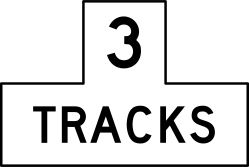
Correct answer: How many separate sets of tracks the crossing has
The plate under a crossbuck counts the sets of rails at that spot. Where there is more than one, a passing train can hide a second one, so clear every track before moving.
11. You are driving a bus toward a drawbridge that has no signal light and nobody directing traffic. You must:
Correct answer: Stop no less than 50 feet ahead of the draw and check that it is fully closed
With nothing controlling traffic, the stop is entirely on you. Halt well back from the draw and confirm with your own eyes that the span is down before you move onto it.
12. When you plan to turn, you should signal:
Correct answer: Early and well before the turn, and keep signaling through it
Signal early and continuously — well before you turn — and keep signaling through the turn. Because trucks move and stop slowly, other drivers need extra warning of what you intend to do.
13. When you use a fire extinguisher on a vehicle fire, you should aim:
Correct answer: At the base or source of the fire
Aim at the base or source of the fire, not at the flames, and stay upwind. Get as close as is safe, and use the right type of extinguisher — water can spread an electrical or grease fire.
14. Because a loaded commercial vehicle accelerates slowly, when crossing or entering traffic you need:
Correct answer: A much larger gap than a car needs
A heavy vehicle needs a much larger gap than a car to cross or pull into traffic. It takes far longer to reach traffic speed, so be sure you have plenty of room before you commit.
15. Convex ('spot' or 'fish-eye') mirrors on a commercial vehicle:
Correct answer: Show a wider view but make objects look smaller and farther away than they are
Convex mirrors show a wider area than flat mirrors, but they make objects look smaller and farther away than they really are. Keep this in mind so you do not misjudge how close a vehicle beside you actually is.
16. You are approaching a railroad crossing in heavy, stop-and-go traffic. You should:
Correct answer: Wait until there is room for your entire vehicle on the far side before crossing
Do not start onto the tracks until there is room on the other side for your whole vehicle. Moving onto the tracks because traffic is backed up ahead of you can leave you trapped in the path of a train.
Source: New York State CDL Manual — Railroad-Highway Crossings
17. An inspector orders your truck out of service, you drive it anyway, and you are convicted. A first offense costs your CDL for at least:
Correct answer: 90 days
Breaking an out-of-service order the first time costs you three months of commercial driving. A second violation inside ten years costs a year, and a third costs three years.
Source: New York CDL Manual — Disqualifications and Penalties
18. Which driving error is typical of somebody who has been drinking?
Correct answer: Wandering across the lane lines and reacting late to hazards
Drink slows reaction time and ruins lane keeping. Weaving, jerky starts, running a red light, and driving far too fast or far too slow are all listed as effects of alcohol.
Source: New York CDL Manual — Alcohol, Other Drugs, and Driving
19. Wearing your seat belt while driving a commercial vehicle is:
Correct answer: Required, and important for keeping control in a crash
Seat belts are required and save lives. A belted driver is far more likely to stay in the seat and keep control during a crash or an emergency maneuver, so buckle up on every trip.
20. A sign reading 'LOW CLEARANCE 12 FT 6 IN' above an underpass is most important to a driver because:

Correct answer: It tells you the maximum height that can safely pass under the structure
A low-clearance sign warns of limited overhead room. If your loaded vehicle is taller than the posted clearance, you must find another route — striking a bridge or overpass can be catastrophic. Don't assume you'll fit.