New York CDL — General Knowledge practice
New York CDL — General Knowledge: Road Signs practice test
Learn the shapes, colors, and meanings of regulatory, warning, and guide signs — from stop and yield to construction and school-zone signs.
Content reviewed against official driver handbooks · August 12, 2026
11 questions · pass with 9 correct. You get instant feedback and an explanation after every answer.
Choose your level
Up to 20 questions on this topic, with feedback after every answer.
Study questions with answers
11 sample Road Signs questions with the correct answer, a short explanation, and the official handbook reference. Read through them, then take the quiz above.
Show all 11 questions with answers
1. At some grade crossings a small plate showing a number is mounted below the crossbuck. That number tells you:
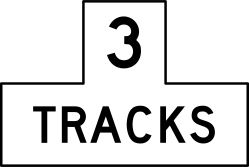
Correct answer: How many separate sets of tracks the crossing has
The plate under a crossbuck counts the sets of rails at that spot. Where there is more than one, a passing train can hide a second one, so clear every track before moving.
2. A sign reading 'LOW CLEARANCE 12 FT 6 IN' above an underpass is most important to a driver because:

Correct answer: It tells you the maximum height that can safely pass under the structure
A low-clearance sign warns of limited overhead room. If your loaded vehicle is taller than the posted clearance, you must find another route — striking a bridge or overpass can be catastrophic. Don't assume you'll fit.
3. A round sign with a black symbol on a yellow background is posted well ahead of a public railroad crossing. What is it telling you to do?

Correct answer: Cut your speed, look and listen for a train, and be ready to stop short of the rails
That round yellow marker is an advance warning that rails are coming up. Ease off your speed, check both directions for a train, and be ready to halt short of the tracks.
4. The white X-shaped crossbuck standing at a highway-rail grade crossing means that you must:
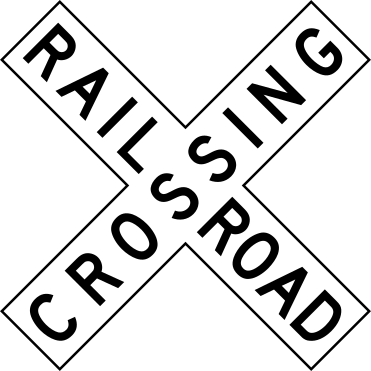
Correct answer: Give any approaching train the right of way
A crossbuck marks the grade crossing itself. Trains always come first there, so an approaching train has to clear before you may roll onto the rails.
5. A diamond-shaped, yellow (or fluorescent yellow-green) sign tells a driver:

Correct answer: There is a warning about a condition or hazard ahead
Yellow diamond signs are warning signs. They alert you to a hazard or change ahead — such as a curve, merge, or crossing — so you can slow down and prepare. This matters even more for a heavy vehicle that needs extra room.
6. Speed limit signs posted on freeway entrance and exit ramps should be read by a commercial driver as:
Correct answer: A number set for cars, which may still be too fast for a heavy vehicle
Ramp speeds are figured for passenger cars. A tall or heavily loaded rig can slide or tip at that same number, especially where the ramp curves and drops at once, so get slowed down before the curve starts.
7. A shipper puts diamond-shaped hazard labels on packages of hazardous materials in order to:
Correct answer: Warn dock crews and drivers about the risk inside
Hazard labels exist to communicate the danger. Anyone loading or hauling the package can read the hazard class before touching it, and a tag is used when the label will not fit on the container.
8. A four-digit number shown on a placard, or on an orange panel fixed to a tank, is there to:
Correct answer: Let emergency crews identify the material being hauled
Those four digits, printed after the letters NA or UN, point first responders to the product in the emergency guidebook so they know what they are dealing with at a spill or crash.
9. You come up behind a vehicle displaying a triangular emblem with a red border and an orange center. That emblem identifies:
Correct answer: A machine that travels far below the speed of normal traffic
The triangle is the slow-moving vehicle symbol, carried by farm and construction machinery and similar equipment. Spotting one early gives you time to brake or change lanes before you close the gap.
10. When a load requires hazardous materials placards, how many placards must the vehicle display and where do they go?
Correct answer: At least four matching placards, on the front, the rear and both sides
A placarded load has to be identified from every direction, so the same placard is fixed to the nose, the tail and each side of the unit — four of them at a minimum.
11. Besides a special transit permit, an over-length or over-width load may legally require:
Correct answer: Warning signs, flags and flashing lights, and sometimes escort vehicles
Outsized loads have to be made obvious to everyone else on the road. Depending on the trip that can mean marker signs, flags, lamps, and a police or pilot escort, and the hours you may travel are often limited.
Source: New York CDL Manual — Cargo Needing Special Attention
More CDL — General Knowledge topics
Practice Road Signs in another state
Every New York question is written from the official New York driver handbook and checked against its current edition. DMV Test Free is a free, independent study resource — not affiliated with any DMV or government agency. About DMV Test Free