Free Arkansas DMV Motorcycle Practice Test 2026
The Arkansas Motorcycle knowledge test has ~25 questions, and you need ~20 correct (~80%) to pass. Practice free with questions written from the official Arkansas driver handbook — every one has a clear explanation, and you can retake as often as you like with no sign-up.
Content reviewed against official driver handbooks · August 12, 2026
What's on the Arkansas written test
The Arkansas Motorcycle knowledge test has ~25 questions; you need ~20 correct (~80%) to pass.
Based on the official Arkansas exam format — always confirm current details with your state DMV.
Practice by topic
Focus on one area at a time — each topic has its own set of Arkansas practice questions.
Helmets, eye protection, and abrasion-resistant gear — what the motorcycle handbook requires and why each piece matters in a crash.
Throttle, clutch, both brakes, and shifting — the controls you must operate smoothly before the road test.
Countersteering, the slow-look-press-roll technique, and choosing the right line through a curve at motorcycle speeds.
Using both brakes together, stopping quickly without locking a wheel, and recovering from a skid.
Where to position yourself in the lane to be seen, managing blind spots, and sharing the road safely with cars and trucks.
Conspicuity — reflective and bright clothing, headlight use, and lane position that make a rider easier for drivers to see.
Gravel, wet pavement, grooved roads, and railroad tracks — reading and handling surfaces that matter far more on two wheels.
Learn the shapes, colors, and meanings of regulatory, warning, and guide signs — from stop and yield to construction and school-zone signs.
Speed limits, turning and signaling rules, headlight and seat-belt requirements, and the everyday laws every driver must follow.
Who goes first at intersections, four-way stops, roundabouts, and crosswalks, and how to yield to pedestrians and emergency vehicles.
Blood alcohol limits, zero-tolerance and implied-consent laws, and how alcohol and drugs — legal or not — affect your driving.
How to pass the first time
- Read the official Arkansas driver handbook at least once before test day.
- Practice by topic to find your weak spots, then fix them.
- Take full-length practice tests until you pass comfortably every time.
- Read every explanation — understanding beats memorizing.
Arkansas Motorcycle test — frequently asked questions
How many questions are on the Arkansas Motorcycle test?
The Arkansas Motorcycle knowledge test has ~25 questions, and you need ~20 correct (~80%) to pass. Our practice tests mirror that format.
How many questions can I miss on the Arkansas Motorcycle test?
You can miss up to ~5 of the ~25 questions and still pass — you need ~20 correct, which is ~80%.
Can I retake the practice test?
Yes — practice as often as you like, completely free. The questions and answer choices are shuffled each time.
Can I take the Arkansas practice test in Spanish?
Yes. Every question here is available in English and Spanish — switch languages anytime. Many states also offer the real knowledge test in languages other than English; confirm what Arkansas offers with your DMV.
Can I practice on my phone?
Yes. The practice tests work in any mobile or desktop browser — no app or sign-up needed — so you can study anywhere.
Are these the real DMV test questions?
No. Our questions are original, written from the current official Arkansas driver handbook to match the real test's topics and style. We are not affiliated with any DMV or government agency.
What's the best way to study?
Read the Arkansas driver handbook, practice by topic to target weak areas, and finish with full-length tests until you consistently pass.
Other Arkansas practice tests
Take the Motorcycle test in another state
Every Arkansas question is written from the official Arkansas driver handbook and checked against its current edition. DMV Test Free is a free, independent study resource — not affiliated with any DMV or government agency. About DMV Test Free
Arkansas Motorcycle questions with answers
20 sample questions from the Arkansas Motorcycle question bank — each with the correct answer, a short explanation, and the section of the official handbook it comes from.
Show all 20 questions with answers
1. How large a share of motorcycle and car crashes involves a driver taking a rider's right-of-way?
Correct answer: More than half
More than half of all motorcycle and car collisions happen because a driver violated the rider's right-of-way, with left-turning cars and vehicles pulling out of side streets the biggest dangers.
Source: Motorcycle Operator Manual — Intersections
2. Where should a rider look while taking a curve?
Correct answer: Through the curve toward where you want to go, turning the head but not the shoulders
Look through the curve toward where you intend to go, turn your head without swinging your shoulders around, and hold your eyes level with the horizon.
Source: Motorcycle Operator Manual — Basic Vehicle Control, Turning
3. What penalty does Arkansas set for passing a stopped school bus that has its red lights flashing?
Correct answer: A misdemeanor, with a fine from $250 to $1,000 and up to ninety days in jail
The offense is a misdemeanor, and conviction brings a fine of at least $250 and no more than $1,000, up to ninety days in jail, or both.
Source: Arkansas Driver License Study Guide — Chapter 1, School Bus Law and Rules
4. Some riding jackets and pants are sold with armor inserts. What are those inserts there for?
Correct answer: They add protection at the parts of the body most at risk
Pads of body armor are built into the areas most likely to take a hit, adding protection on top of what the fabric or leather gives on its own.
Source: Motorcycle Operator Manual — Wear the Right Gear, Clothing
5. At what angle should you approach a small obstacle you cannot ride around?
Correct answer: As close to 90 degrees as possible
Try to avoid the obstacle by slowing or going around it, but if you must cross it, meet it as close to a right angle as you can and look where you want to end up.
Source: Motorcycle Operator Manual — Handling Dangerous Surfaces, Uneven Surfaces and Obstacles
6. When should mirrors be cleaned and adjusted, and what should they show?
Correct answer: Before starting out, aimed so each shows the lane behind you and the one alongside
Set the mirrors before you start out, since riding one-handed to adjust one is difficult, and aim each so it shows the lane behind you and the lane beside you.
Source: Motorcycle Operator Manual — Know Your Motorcycle, Check Your Motorcycle
7. How often should a rider use both brakes when slowing or stopping?
Correct answer: Every time you slow down or stop
The manual asks for both controls every single time you slow or stop, because using them together on ordinary stops is what builds the habit you will need in an emergency.
Source: Motorcycle Operator Manual — Basic Vehicle Control, Braking
8. What do yellow diamond-shaped signs with black symbols tell you?

Correct answer: That a hazard or special situation lies ahead, so slow down and be ready to stop
Warning signs are yellow with black symbols or lettering and mostly diamond-shaped; they tell you to slow down, be ready to stop if you must, or alert you to a hazard ahead.
Source: Arkansas Driver License Study Guide — Chapter 2, Warning Signs
9. Hazards appear on your left only. Which paths of travel does the manual suggest?
Correct answer: Path 2 or path 3
With trouble on the left alone, ride in path 2 or path 3; if the hazards are on the right instead, stay in path 1 or path 2.
Source: Motorcycle Operator Manual — Keeping Your Distance, Lane Positions
10. How long do the effects of cannabis last when it is eaten rather than smoked?
Correct answer: More than six hours, with onset possibly delayed over an hour
Smoked cannabis takes effect within a few minutes and lasts roughly two to four hours, but eaten cannabis may not take hold for more than an hour and the effects can run beyond six hours.
Source: Motorcycle Operator Manual — Cannabis and Motorcycle Operation
11. What is the manual's advice about relying on a motorcycle horn?
Correct answer: It is not as loud as a car horn, so use it but do not rely on it
A motorcycle horn is not as loud as a car's, so use it, but do not depend on it; time and space to maneuver matter more.
Source: Motorcycle Operator Manual — Increasing Conspicuity, Horn
12. Who must yield when a driver turns left across oncoming traffic?
Correct answer: The driver turning left, who must yield to oncoming traffic going straight
A driver turning left has to give way to oncoming vehicles that are continuing straight ahead.
Source: Arkansas Driver License Study Guide — Chapter 3, Right of Way
13. What typically goes wrong when a rider enters a curve too fast?
Correct answer: They drift into another lane or off the road, or brake so hard they skid
Riders who cannot hold the line they started end up crossing into another lane or leaving the road, or they panic and brake so hard that they skid and lose control.
Source: Motorcycle Operator Manual — Basic Vehicle Control, Turning
14. On an Arkansas road with three or more lanes running the same way, which lane should you normally use?
Correct answer: The right lane, except to pass
Stay in the right lane except when passing; where there is heavy merging traffic, use the center travel lane instead.
Source: Arkansas Driver License Study Guide — Chapter 3, General Driving
15. When do most motorcycle crashes happen?
Correct answer: On short trips of under five miles, only minutes after setting out
Most crashes come early in short outings of under five miles, which is why gear belongs on before you leave the driveway rather than once you reach open road.
Source: Motorcycle Operator Manual — Wear the Right Gear, Helmet Use
16. If you cannot avoid a road covered with snow or ice, what does the manual advise?
Correct answer: Keep it straight up, go as slowly as possible, and stay off the brakes
Keep the motorcycle upright, go as slowly as you can, stay off the brakes, and squeeze the clutch and coast if you can; at walking pace you may let your feet skim the surface.
Source: Motorcycle Operator Manual — Handling Dangerous Surfaces, Slippery Surfaces
17. What happens if you change down into a lower gear while still moving too fast for it?
Correct answer: The motorcycle lurches and the rear wheel may skid
Downshifting at too high a road speed makes the motorcycle lurch, and the rear wheel can break traction and skid.
Source: Motorcycle Operator Manual — Basic Vehicle Control, Shifting Gears
18. How should pressure be fed into the front brake lever?
Correct answer: Smoothly and firmly, with progressively more force
Squeeze the lever smoothly, firmly, and with steadily rising force; grabbing at it or slamming pressure on can lock the wheel.
Source: Motorcycle Operator Manual — Basic Vehicle Control, Braking
19. What does a speed limit sign tell an Arkansas driver?
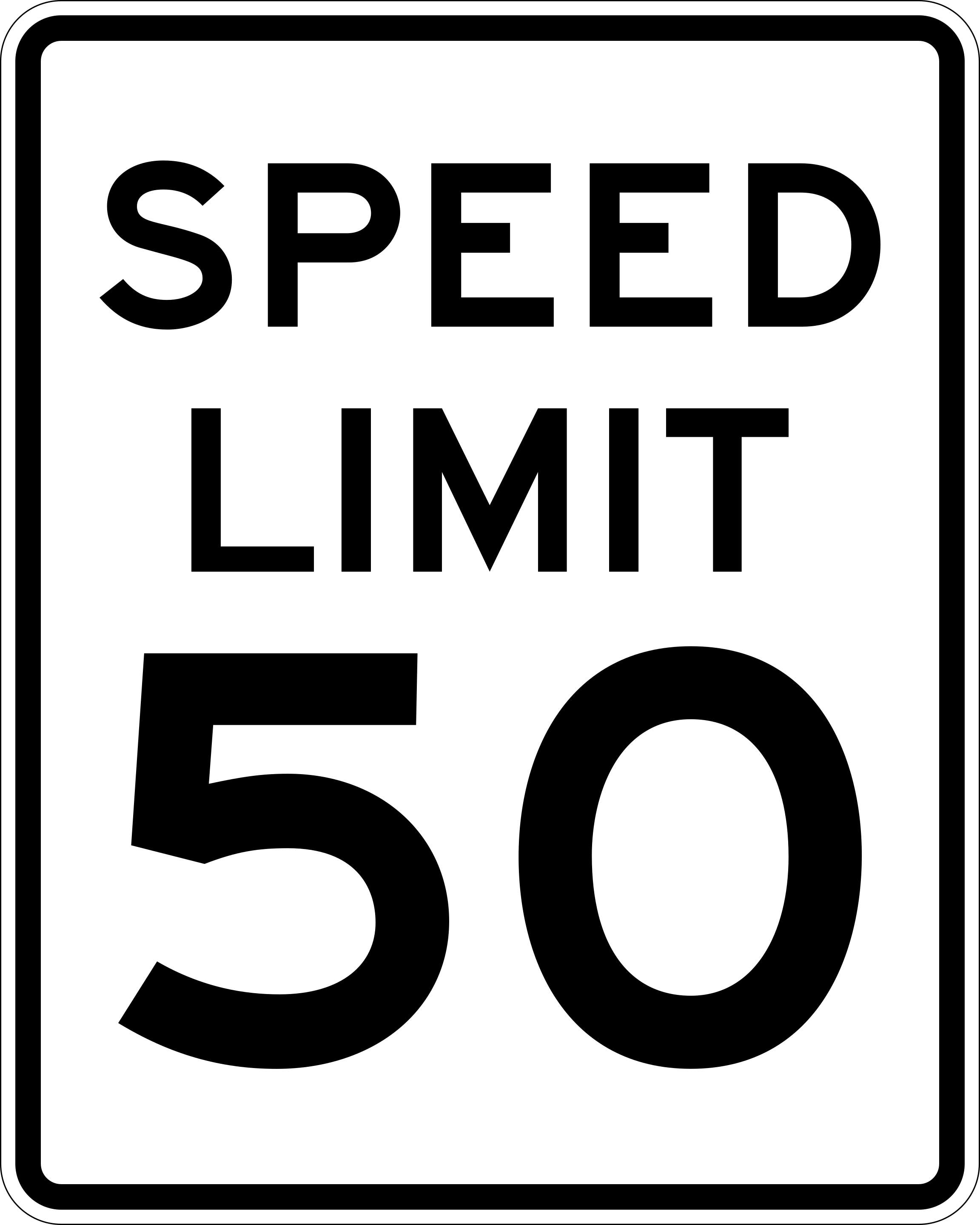
Correct answer: The minimum and maximum allowed, with the maximum meant for ideal conditions
A speed limit sign posts the minimum and the maximum allowed on that stretch of road, and the maximum assumes ideal conditions, so it should come down when the road is slick or visibility is poor.
Source: Arkansas Driver License Study Guide — Chapter 2, Speed Limit Sign
20. A row of parked cars lines the curb on your right. Which part of your lane does the manual want?
Correct answer: The left side, moving to the center when traffic is coming the other way
Holding the left side of the lane buys room for doors swung open and for people stepping out between the cars, though when traffic is coming the other way the center of the lane protects both sides at once.
Source: Motorcycle Operator Manual — Intersections, Passing Parked Cars