Texas Car / Permit practice
Texas Car / Permit: Parking & Stopping practice test
Legal and illegal parking, colored curbs, distances from hydrants and crossings, and how to park safely on hills.
Content reviewed against official driver handbooks · August 12, 2026
13 questions · pass with 10 correct. You get instant feedback and an explanation after every answer.
When is your test?
- This weekGet the plan — $4.99
Texas Permit & CDL Tests: 1‑Day Study Plans
Our own study plan. Its questions are free here; its lessons are only in this plan.
- Weeks awayGet the pack — $4.99
Texas Practice Test Pack — 2026 Printable Edition
Our own printable edition — nobody paid us to show it to you, and everything in it is free to read here too.
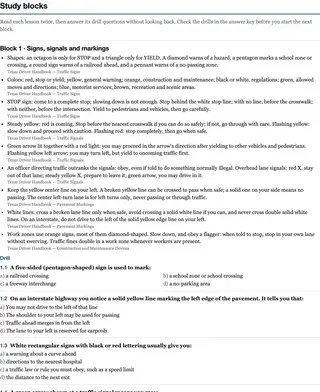
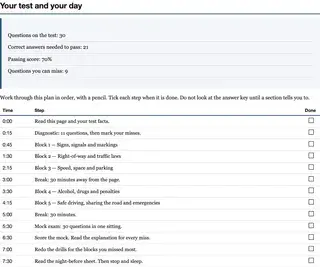
- One-time purchase
- Instant download
- 14-day refund
Study questions with answers
12 sample Parking & Stopping questions with the correct answer, a short explanation, and the official handbook reference. Read through them, then take the quiz above.
Show all 12 questions with answers
1. Texas law prohibits parking within how many feet of a crosswalk at an intersection?
Correct answer: 20 feet
Texas prohibits parking, standing or idling within 20 feet of a crosswalk at an intersection. The same list sets other distances: 15 feet from a fire hydrant, and 30 feet from a flashing signal, stop sign, yield sign or similar signal beside the road. Five or fifty feet is not the crosswalk distance, so measure 20 feet.
Source: Texas Driver Handbook — Parking
2. You have to leave your car on the pavement of a rural highway because there is nowhere off the road to put it. Besides leaving room for others to get by, you must make sure that:
Correct answer: It can be seen from 200 feet away in each direction
When you cannot park off the road outside a business or residential district, leave plenty of room for others to pass and make sure drivers coming from either direction can see your vehicle from at least 200 feet. At night, use parking lights or dim headlights. Facing the direction of travel or being unlocked is not required.
Source: Texas Driver Handbook — Parking
3. Texas keeps parked vehicles clear of the driveway entrance to a fire station by at least:
Correct answer: 20 feet
You may not park, stand or idle within 20 feet of the driveway entrance to a fire station. On the opposite side of the street, the restricted area extends to 75 feet from the entrance. Other parking limits include 15 feet from a fire hydrant, 20 feet from a crosswalk at an intersection, and 30 feet from a stop sign or signal.
Source: Texas Driver Handbook — Parking
4. When you park facing uphill next to a curb, you should turn your front wheels:
Correct answer: away from the curb, so the tire will catch the curb if it rolls back
Facing uphill beside a curb, turn the wheels away from the curb so the back of the front tire faces it. If the car rolls back, the tire catches the curb instead of letting the car roll downhill.
Source: Texas Driver Handbook — Parking
5. The diagonally striped area painted beside a space reserved for drivers with disabilities is there to:
Correct answer: Give room for a wheelchair lift or ramp, so no vehicle may park there
Those stripes are working room for a lift or a ramp, not an extra spot. Parking in them, or in the striped strip in front of a business entrance next to such a space, is prohibited.
Source: Texas Driver Handbook — Parking
6. When you park facing uphill on a road with no curb, you should turn your front wheels:
Correct answer: to the right, toward the edge of the road
The Texas handbook's hill-parking diagram shows that when there is no curb, you turn the wheels to the right, toward the edge of the road, so a car that rolls heads off the road rather than into traffic.
Source: Texas Driver Handbook — Parking
7. When you finish parking parallel to a curb, your tires should be within about:
Correct answer: 18 inches of the curb
When you park parallel on a road that allows two-way traffic, your right-hand wheels must be within 18 inches of the curb or the road's right edge. Leaving more space sticks your car out into traffic. You do not need to touch the curb, and parking three or five feet away would break the rule.
Source: Texas Driver Handbook — Parking
8. The closest you may leave a parked vehicle to the nearest rail at a railroad crossing is:
Correct answer: 50 feet
Do not park a vehicle closer than 50 feet to the nearest rail at a railroad crossing, whether anyone is in it or not. That is a different rule from stopping at a crossing, where you stay 15 to 50 feet from the nearest rail if lights flash, bells sound or a flag person directs you. For parking, the number is 50 feet.
Source: Texas Driver Handbook — Parking
9. If you must leave a vehicle parked on an unlighted highway overnight, you should:
Correct answer: Leave the parking lights, or the headlights on low beam, turned on
When a vehicle must be parked on an unlighted highway at night, leave the parking lights or the low-beam headlights on, so other drivers can see the vehicle. Turning everything off leaves a car that is hard to see. The handbook does not list switching off all lights, high beams, or flashing hazards as the method.
Source: Texas Driver Handbook — Parking
10. When you park facing downhill next to a curb, you should turn your front wheels:
Correct answer: toward the curb
Facing downhill, turn your wheels toward the curb. If the car rolls, the front tire catches the curb and stops it from rolling into traffic.
Source: Texas Driver Handbook — Parking
11. Before you walk away from a parked car, Texas law requires you to:
Correct answer: Shut off the engine, lock the ignition, take the key, and set the brake
It is illegal to leave your car standing unattended with the engine running, so you must turn off the engine, lock the ignition, take out the key and set the brake. On any grade, also point the front wheels toward the curb or the edge of the road. Leaving the motor running because it is cold, or leaving the car in neutral, breaks the rule.
Source: Texas Driver Handbook — Parking
12. You may not park within how many feet of a fire hydrant in Texas?
Correct answer: 15 feet
Texas bars you from parking or standing within 15 feet of a fire hydrant, so firefighters can reach it. The same list sets other limits: 20 feet from a crosswalk at an intersection, and 30 feet before a flashing signal, stop sign, yield sign or similar traffic signal beside the road. Fifteen feet is the hydrant distance.
Source: Texas Driver Handbook — Parking
More Car / Permit topics
Practice Parking & Stopping in another state
Every Texas question is written from the official Texas driver handbook and checked against its current edition. DMV Test Free is a free, independent study resource — not affiliated with any DMV or government agency. About DMV Test Free
Study offline
Texas Practice Test Pack — 2026 Printable Edition
$4.99 · One-time purchase. Instant download.
Our own printable edition — nobody paid us to show it to you, and everything in it is free to read here too.