Florida Car / Permit practice
Florida Car / Permit: Parking & Stopping practice test
Legal and illegal parking, colored curbs, distances from hydrants and crossings, and how to park safely on hills.
Content reviewed against official driver handbooks · August 12, 2026
10 questions · pass with 8 correct. You get instant feedback and an explanation after every answer.
Choose your level
Up to 20 questions on this topic, with feedback after every answer.
When is your test?
- This weekGet the plan — $4.99
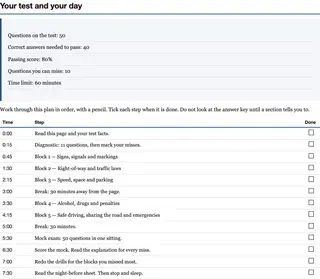
Florida Permit & CDL Tests: 1‑Day Study Plans
Our own study plan. Its questions are free here; its lessons are only in this plan.
- Weeks awayGet the pack — $4.99
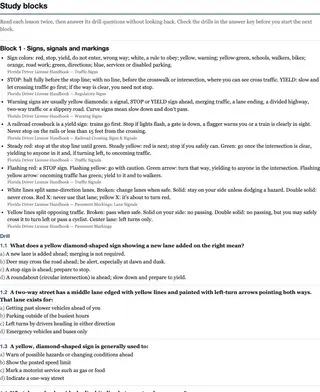
Florida Practice Test Pack — 2026 Printable Edition
Our own printable edition — nobody paid us to show it to you, and everything in it is free to read here too.
- One-time purchase
- Instant download
- 14-day refund
Study questions with answers
10 sample Parking & Stopping questions with the correct answer, a short explanation, and the official handbook reference. Read through them, then take the quiz above.
Show all 10 questions with answers
1. When you park facing downhill next to a curb, you should turn your front wheels:
Correct answer: Toward the curb
Facing downhill, turn the wheels toward the curb. If the car rolls, the curb blocks the front tire and keeps it from rolling into traffic.
2. Before you leave your parked vehicle, you should:
Correct answer: Set the parking brake, shift to park (or into gear), and remove the key
Always set the parking brake, put an automatic in Park (or a manual in gear), turn off the engine, and take your key. This keeps the vehicle from rolling and from being taken.
3. After you finish parallel parking next to a curb, your wheels should be no more than about:
Correct answer: 12 inches (one foot) from the curb
After parallel parking, your tires should sit within about 12 inches of the curb so the vehicle does not stick out into the travel lane.
4. When you park facing uphill next to a curb, your front wheels should be turned:
Correct answer: Away from the curb, so the tire rolls back against it
Facing uphill with a curb, turn the wheels away from the curb. If the car rolls back, the front tire settles against the curb and stops it.
5. How close to a railroad crossing may you lawfully leave a parked vehicle?
Correct answer: No nearer than 50 feet
Parking is banned within 50 feet of a railroad crossing, which keeps sight lines open and keeps vehicles clear of the path a train will take.
6. The curb along an empty stretch of street has been painted yellow. What is that telling you?
Correct answer: Parking along that curb is not allowed
Yellow paint on a curb marks a zone where parking is banned, often close to a hydrant or a junction, and leaving a car there breaks the law.
7. Who may legally park in a space marked with the blue wheelchair (disabled parking) symbol?
Correct answer: Only a vehicle displaying a valid disabled parking permit or plate
Spaces reserved for people with disabilities may be used only by vehicles that display a valid disabled parking permit or license plate—no matter how briefly you stop.
8. You are leaving your car on a road that runs uphill, and there is no curb at the roadside. Which way should the front wheels point?
Correct answer: To the right, pointing off toward the shoulder
With no curb to catch a tire, aim the wheels to the right so that a car which starts to roll drifts off the road rather than into passing traffic. Set the parking brake as well.
9. You may not park within how many feet of a fire hydrant?
Correct answer: 15 feet
Parking is prohibited within 15 feet of a fire hydrant so firefighters can reach it quickly in an emergency.
10. In which of these places is stopping, standing, or parking prohibited?
Correct answer: On a crosswalk or within an intersection
You may not stop, stand, or park on a crosswalk, within an intersection, on a bridge, in a tunnel, or where you would block traffic or a driveway. These spots endanger others and obstruct the road.
More Car / Permit topics
Practice Parking & Stopping in another state
Every Florida question is written from the official Florida driver handbook and checked against its current edition. DMV Test Free is a free, independent study resource — not affiliated with any DMV or government agency. About DMV Test Free
Study offline
Florida Practice Test Pack — 2026 Printable Edition
$4.99 · One-time purchase. Instant download.
Our own printable edition — nobody paid us to show it to you, and everything in it is free to read here too.