Texas Car / Permit practice
Texas Car / Permit: Signals & Pavement Markings practice test
How to read traffic signals, lane lines, and pavement markings — including yellow and white lines, arrows, and flashing lights.
Content reviewed against official driver handbooks · August 12, 2026
12 questions · pass with 10 correct. You get instant feedback and an explanation after every answer.
Choose your level
Up to 20 questions on this topic, with feedback after every answer.
When is your test?
- This weekGet the plan — $4.99
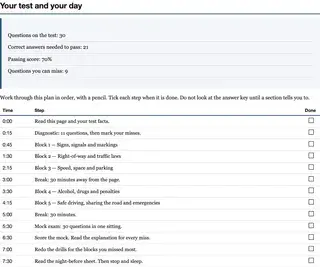
Texas Permit & CDL Tests: 1‑Day Study Plans
Our own study plan. Its questions are free here; its lessons are only in this plan.
- Weeks awayGet the pack — $4.99
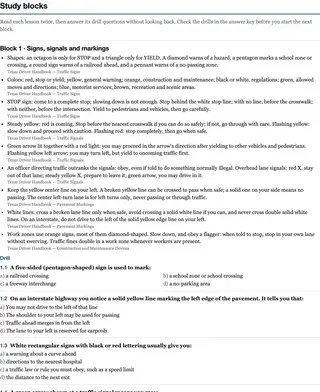
Texas Practice Test Pack — 2026 Printable Edition
Our own printable edition — nobody paid us to show it to you, and everything in it is free to read here too.
- One-time purchase
- Instant download
- 14-day refund
Study questions with answers
12 sample Signals & Pavement Markings questions with the correct answer, a short explanation, and the official handbook reference. Read through them, then take the quiz above.
Show all 12 questions with answers
1. A traffic signal showing a flashing red light means you should:
Correct answer: stop, then proceed when it is safe, just as you would at a stop sign
A flashing red light means stop completely before the crosswalk or intersection, then go when you can do so safely, much like a stop sign. Slowing down is not enough. The intersecting road's traffic may not have to stop, so check carefully before you move, and never treat the signal as if it were out of order.
2. A green arrow shown at a traffic signal means you may:
Correct answer: turn in the direction of the arrow, yielding to pedestrians already crossing
A green arrow shown together with a red light means you may proceed carefully in the direction of the arrow, after you yield the right-of-way to other vehicles and pedestrians. You do not need to wait for a plain green light, and the arrow lets you turn only the way it points, not drive straight on.
3. A wide white line is painted across your lane at a signalized intersection. Where must you stop?
Correct answer: Behind the painted line
White stop lines are painted across the lanes at signs and signals, and where they are present you must stop behind the line. If there is no stop line, stop before the crosswalk when a sign, signal or pedestrian requires it. Stopping in the crosswalk or past the line blocks pedestrians and puts you in the intersection.
4. A steady (not flashing) yellow traffic light means:
Correct answer: the light is about to turn red, so prepare to stop
A steady yellow light warns you the signal is about to change to red. If you can stop safely, stop before the nearest crosswalk. Only if stopping safely is impossible may you continue cautiously through before it turns red. Speeding up to beat the light is wrong, but a yellow also does not close the intersection or require you to stay stopped.
5. On a busy street, a center lane set aside as a shared left-turn lane may be used for:
Correct answer: slowing down or stopping to make a left turn
The center lane is only for vehicles turning left, and should never serve for passing or through traffic. You should enter it only where you will have time to slow down or stop for a safe left turn. It is not a parking lane or a lane reserved for certain vehicles, and a green signal shows when you may turn.
6. Two solid white lines run side by side between the lanes of the road you are on. Moving across them is:
Correct answer: Not permitted at all
Crossing is prohibited where the pavement is marked with double solid white lines. A broken white line, in contrast, lets you change lanes if it is safe, and even a single solid white line should be avoided if possible. Signaling, daylight and an upcoming exit do not change the rule about double solid white lines.
7. A flashing yellow arrow appears for your left-turn lane. What does it permit?
Correct answer: Begin the turn once you have yielded to vehicles coming toward you
A flashing yellow arrow lets you turn left, but you must give way to oncoming traffic before you go. So you begin the turn only after vehicles coming toward you have passed or stopped. It is not a protected turn like a green arrow, you do not have to wait for one, and an officer's wave is not needed.
8. Dashed white lines painted between lanes tell you that:
Correct answer: you may change lanes across them when it is safe
Broken or dashed lines permit you to change lanes if it is safe, while a solid white line should be avoided if possible and double solid white lines prohibit crossing. Dashed lines do not mean the lane is ending or that lane changes are banned. Check your mirrors and blind spot, signal, and move over only when the way is clear.
9. Overhead lane-control signals show a red X above one of the lanes on the road you are using. This tells you to:
Correct answer: Stay out of the lane under that signal
Lane-use control signals are mounted over individual lanes. A red X above a lane tells you not to drive in that lane. A steady yellow X means get ready to leave the lane because a change is being made, and a steady green arrow pointing down means the lane is open to you. A red X is not a stop-and-wait signal.
10. A flashing yellow traffic light means:
Correct answer: slow down and proceed with caution
A flashing yellow light warns you to slow down and proceed with caution. It is not a stop signal, so you do not need to wait for green, though you must watch for other traffic and pedestrians. A flashing red light is the one that requires a full stop. A flashing yellow arrow means turn left only after yielding to oncoming traffic.
11. On an interstate highway you notice a solid yellow line marking the left edge of the pavement. It tells you that:
Correct answer: You may not drive to the left of that line
On the left edge of the road, a solid yellow line is a guide telling drivers that driving to the left of it is prohibited. You may see this type of line on interstate highways. It does not mark a passing lane, a carpool lane or a merge point, so keep your vehicle on the right side of the line.
12. On a two-lane road, a solid yellow line painted on your side of the center line means:
Correct answer: you may not pass on your side
A solid yellow line on your side of the center marks a no-passing zone, so you may not cross it to overtake. Only broken or dashed lines allow you to pass or change lanes, and only when it is safe. The line shows where passing is prohibited, no matter how clear the road ahead looks, and it does not mean the road turns one-way.
More Car / Permit topics
Practice Signals & Pavement Markings in another state
Every Texas question is written from the official Texas driver handbook and checked against its current edition. DMV Test Free is a free, independent study resource — not affiliated with any DMV or government agency. About DMV Test Free
Study offline
Texas Practice Test Pack — 2026 Printable Edition
$4.99 · One-time purchase. Instant download.
Our own printable edition — nobody paid us to show it to you, and everything in it is free to read here too.