Texas CDL — General Knowledge practice
Texas CDL — General Knowledge: Parking & Stopping practice test
Legal and illegal parking, colored curbs, distances from hydrants and crossings, and how to park safely on hills.
Content reviewed against official driver handbooks · August 12, 2026
10 questions · pass with 8 correct. You get instant feedback and an explanation after every answer.
Choose your level
Up to 20 questions on this topic, with feedback after every answer.
When is your test?
- This weekGet the plan — $4.99
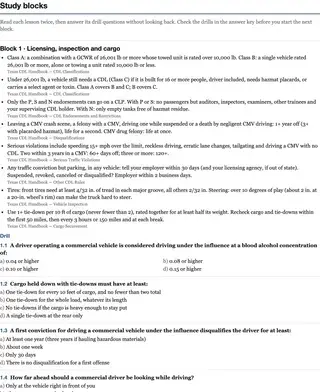
Texas Permit & CDL Tests: 1‑Day Study Plans
Our own study plan. Its questions are free here; its lessons are only in this plan.
- Weeks awayGet the pack — $4.99
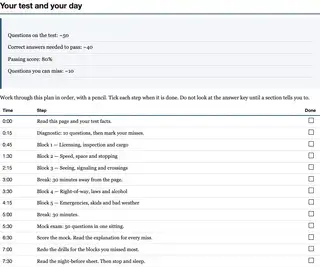
Texas Practice Test Pack — 2026 Printable Edition
Our own printable edition — nobody paid us to show it to you, and everything in it is free to read here too.
- One-time purchase
- Instant download
- 14-day refund
Study questions with answers
10 sample Parking & Stopping questions with the correct answer, a short explanation, and the official handbook reference. Read through them, then take the quiz above.
Show all 10 questions with answers
1. When you pull over for a roadside stop, where should the vehicle end up?
Correct answer: Parallel to the curb or shoulder and clear of driveways, hydrants, and signs
It has to finish parallel to the curb or shoulder and safely out of the traffic stream, and it must not be sitting across a driveway, in front of a hydrant, in an intersection, or blocking a sign.
2. You are stopped on the shoulder of a divided highway. Your three warning devices belong at:
Correct answer: 10 feet, 100 feet, and 200 feet back toward oncoming traffic
On a one-way road or a divided highway, set the triangles at 10 feet, 100 feet, and 200 feet, measured back toward the traffic that is coming at you.
3. When you park a commercial vehicle and leave the cab, you should:
Correct answer: Apply the parking brake and secure the vehicle so it cannot roll
Apply the parking brake whenever you leave the vehicle, and on a grade turn the wheels and use chocks as needed so the vehicle cannot roll.
Source: Texas CDL Handbook — Parking
4. There are two times you should leave the parking brakes off. They are when the brakes are:
Correct answer: Still very hot from a long grade, or soaked while the temperature is below freezing
Very hot brakes, just off a steep grade, can be damaged by the heat if you set them. Brakes that are soaking wet in freezing weather can lock up with ice so the vehicle will not move.
5. After you stop on a road or the shoulder beside it, how soon must your emergency warning devices be out?
Correct answer: Within ten minutes
The devices have to be in place within ten minutes of the stop. Waiting longer leaves approaching drivers with nothing to warn them that a large vehicle is sitting there.
6. If you must stop your vehicle along the road, you should:
Correct answer: Pull as far off the road as you can, turn on your flashers, and set out warning devices
Pull as far off the road as possible, turn on your four-way flashers, and set out warning devices so other drivers can see your stopped vehicle in time.
7. A hill behind your stopped rig hides it from drivers until they are almost on top of you. You should:
Correct answer: Carry the rear triangle back past the hill so drivers get warning in time
Where a hill, a curve, or another obstruction keeps drivers from seeing you within 500 feet, walk the rear triangle farther back down the road, past the obstruction, so the warning reaches them in time.
8. While you walk out to set your reflective triangles, you should hold them:
Correct answer: In front of you, between your body and the approaching traffic
Carry each triangle in front of you, between your body and the traffic bearing down on you. The reflective surface makes you far easier for approaching drivers to see.
9. Your vehicle has come to a full stop at the roadside. What is the right order of the next steps?
Correct answer: Cancel the turn signal, switch on the four-ways, set the parking brake, then select neutral or park
Cancel the turn signal first, then switch on the four-way flashers, set the parking brake, put the gearshift in neutral or park, and finally take your feet off the brake and clutch.
10. Texas safe backing advice tells drivers to pick a parking spot where:
Correct answer: You can drive away forward instead of having to reverse out
Backing is the riskiest thing a long vehicle does, so choose a space you can leave going forward. Where you must use a driveway, back in from the street so you can drive out facing the traffic you need to see.
More CDL — General Knowledge topics
Practice Parking & Stopping in another state
Every Texas question is written from the official Texas driver handbook and checked against its current edition. DMV Test Free is a free, independent study resource — not affiliated with any DMV or government agency. About DMV Test Free
Study offline
Texas Practice Test Pack — 2026 Printable Edition
$4.99 · One-time purchase. Instant download.
Our own printable edition — nobody paid us to show it to you, and everything in it is free to read here too.