Florida CDL — General Knowledge practice
Florida CDL — General Knowledge: Parking & Stopping practice test
Legal and illegal parking, colored curbs, distances from hydrants and crossings, and how to park safely on hills.
Content reviewed against official driver handbooks · August 12, 2026
10 questions · pass with 8 correct. You get instant feedback and an explanation after every answer.
Choose your level
Up to 20 questions on this topic, with feedback after every answer.
When is your test?
- This weekGet the plan — $4.99
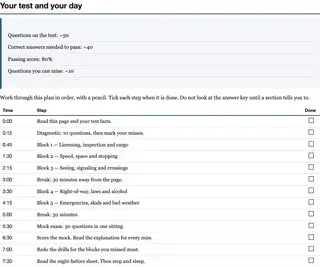
Florida Permit & CDL Tests: 1‑Day Study Plans
Our own study plan. Its questions are free here; its lessons are only in this plan.
- Weeks awayGet the pack — $4.99
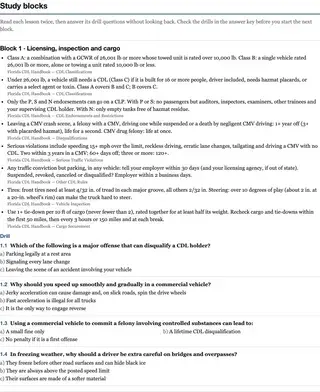
Florida Practice Test Pack — 2026 Printable Edition
Our own printable edition — nobody paid us to show it to you, and everything in it is free to read here too.
- One-time purchase
- Instant download
- 14-day refund
Study questions with answers
10 sample Parking & Stopping questions with the correct answer, a short explanation, and the official handbook reference. Read through them, then take the quiz above.
Show all 10 questions with answers
1. You have stopped just past a crest where drivers cannot see you until they are nearly on top of you. How does that change where the farthest warning device goes?
Correct answer: Carry it farther back down the road, past the crest, so traffic is warned well before it reaches you
A hill or a curve that blocks the view swallows the usual spacing. Walk the farthest device back beyond the obstruction so that approaching traffic gets a warning from at least 500 feet away.
2. Where possible, how should a driver position a large vehicle when parking it?
Correct answer: So that leaving the space can be done by pulling forward
Backing is the most dangerous thing a large vehicle does, because so much of the path behind is hidden. Picking a spot you can drive straight out of removes that risk before it arises.
Source: Florida CDL Handbook — Basic Control of Your Vehicle
3. Your truck is disabled on the shoulder of a highway. How soon must the emergency warning devices be out on the ground?
Correct answer: Within ten minutes of stopping
Ten minutes is the outer limit for getting the devices placed, and sooner is better. Flashers alone are not enough, because a following driver can read taillights as a vehicle that is still moving.
4. A transit coach has an interlock that applies the brakes whenever the rear door is opened. May the driver lean on it instead of the parking brake?
Correct answer: No, it is a passenger safety device and not a substitute for the parking brake
The interlock holds the throttle at idle and keeps the brakes on while riders board, then lets go once the door shuts. Securing a parked coach remains the parking brake's job.
Source: Florida CDL Handbook — Transporting Passengers Safely
5. You have to stop your commercial vehicle on the shoulder of a highway. What should you do?
Correct answer: Pull as far off as possible, turn on flashers, and set out warning triangles
Get as far off the road as you can, turn on your four-way flashers, and set out your emergency warning devices (reflective triangles) so approaching drivers see you in time.
6. What is the safe way to carry a reflective warning triangle out along the roadway?
Correct answer: Held up between your body and the traffic coming toward you
The triangle doubles as your shield: approaching drivers pick up the reflector first and you second. Walking with it hidden leaves you invisible on a live shoulder.
7. Whenever you park and leave a commercial vehicle, you should always:
Correct answer: Set the parking brake and secure it against rolling
Set the parking brake and, on a grade, chock the wheels or turn them toward the curb so the vehicle cannot roll. A heavy vehicle that rolls away can cause serious damage.
Source: Florida CDL Handbook — Basic Control of Your Vehicle
8. What is the right technique for bringing a loaded commercial vehicle to a routine stop?
Correct answer: Build pedal pressure steadily so the vehicle settles into a smooth halt
How much pressure the stop needs depends on your speed and how quickly you have to be stopped, so meter it rather than stabbing at the pedal. With a manual gearbox, push the clutch in as the engine drops toward idle.
Source: Florida CDL Handbook — Basic Control of Your Vehicle
9. You reach a drawbridge that has no signal light and nobody on duty controlling traffic. What must you do?
Correct answer: Halt at least 50 feet short of the draw and make sure it is fully closed
With no one managing the crossing, the check falls to you. A green light or an attendant directing traffic removes the stop, though you still slow down and satisfy yourself that crossing is safe.
Source: Florida CDL Handbook — Transporting Passengers Safely
10. A bus driver is required to stop at a railroad crossing. Where should the bus come to rest?
Correct answer: Somewhere in the band running from 15 to 50 feet ahead of the nearest rail
That window keeps the bus clear of a passing train yet close enough for the driver to see and hear down the line. Opening the front door can sharpen what the driver is able to hear.
Source: Florida CDL Handbook — Transporting Passengers Safely
More CDL — General Knowledge topics
Practice Parking & Stopping in another state
Every Florida question is written from the official Florida driver handbook and checked against its current edition. DMV Test Free is a free, independent study resource — not affiliated with any DMV or government agency. About DMV Test Free
Study offline
Florida Practice Test Pack — 2026 Printable Edition
$4.99 · One-time purchase. Instant download.
Our own printable edition — nobody paid us to show it to you, and everything in it is free to read here too.