Texas CDL — General Knowledge practice
Texas CDL — General Knowledge: Signals & Pavement Markings practice test
How to read traffic signals, lane lines, and pavement markings — including yellow and white lines, arrows, and flashing lights.
Content reviewed against official driver handbooks · August 12, 2026
11 questions · pass with 9 correct. You get instant feedback and an explanation after every answer.
When is your test?
- This weekGet the plan — $4.99
Texas Permit & CDL Tests: 1‑Day Study Plans
Our own study plan. Its questions are free here; its lessons are only in this plan.
- Weeks awayGet the pack — $4.99
Texas Practice Test Pack — 2026 Printable Edition
Our own printable edition — nobody paid us to show it to you, and everything in it is free to read here too.
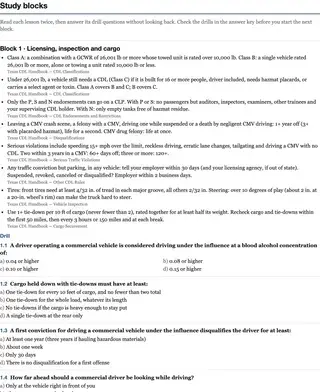
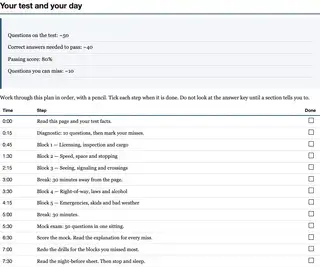
- One-time purchase
- Instant download
- 14-day refund
Study questions with answers
11 sample Signals & Pavement Markings questions with the correct answer, a short explanation, and the official handbook reference. Read through them, then take the quiz above.
Show all 11 questions with answers
1. A driver behind you wants to pass and the road ahead looks clear to you. What should you do?
Correct answer: Keep your hands off the signals and let that driver decide
Never wave or flash another driver through. If your signal turns out to be wrong you could cause a crash, be held responsible for it, and face a very expensive claim. Let the other driver make that judgment.
2. A truck at least 80 inches wide or 30 feet long comes to a stop on a Texas roadway or the shoulder beside it. The driver must:
Correct answer: Turn on the hazard warning lamps immediately
State law says a rig that large has to switch on the flashing hazard lamps the moment it stops on the roadway or shoulder. A vehicle legally parked inside city limits, or one halted to pick up or drop off passengers, is excused.
Source: Texas CDL Handbook — Special Requirements (Equipment)
3. You have just finished a turn in a truck whose signals do not shut off by themselves. You should:
Correct answer: Reach over and switch the signal off yourself
Leaving a signal blinking after the move is done tells other drivers something that is no longer true. If your signals do not cancel on their own, switch them off yourself once the turn or lane change is complete.
4. On a two-lane road, the pavement painted ahead of a railroad crossing carries:
Correct answer: A large X with the letters RR, along with a no-passing marking
The paint ahead of a crossing says the same thing the advance warning sign does. It shows a large X together with the letters RR, and on a two-lane road a no-passing marking goes with it.
5. You should turn on your four-way emergency flashers when:
Correct answer: When you are stopped at the roadside or must drive unusually slowly
Use your four-way flashers when you are stopped or parked at the roadside, and whenever you must drive so slowly that you become a hazard to others.
6. When you plan to turn, you should signal:
Correct answer: Early, well before you begin the turn
Signal early, well before the turn, so other drivers know your plans in time. Keep signaling through the turn and make sure the signal cancels afterward.
7. Texas equipment rules permit flashing lights on:
Correct answer: Emergency vehicles, snow removal machinery, and school buses loading children
Flashing lamps belong on emergency vehicles, on snow removal machinery, and on school buses while children are getting on or off. Tow trucks may also use them at a wreck when an officer directs, or while hooking a disabled vehicle out of the roadway.
Source: Texas CDL Handbook — Special Requirements (Equipment)
8. To warn drivers behind you that you are about to slow down, you can:
Correct answer: Tap the brake pedal to flash your brake lights
Tap the brake pedal a few times to flash your brake lights before slowing. This warns following drivers, who may not expect a heavy vehicle to slow so gradually.
9. How often should you check your mirrors while driving?
Correct answer: Regularly, and always before you change lanes, turn, or merge
Check your mirrors regularly, and always before you change lanes, turn, merge, or slow down, so you know what is happening around your vehicle.
10. Compared with the flat mirrors, the convex or 'spot' mirrors on a truck show:
Correct answer: A wider area, but objects look smaller and farther away than they are
Convex mirrors give a wider view, but they make everything look smaller and farther away than it really is. Keep that in mind when judging distances behind you.
11. When you meet an oncoming vehicle at night, you should:
Correct answer: Switch to low beams before you come within 500 feet of the oncoming vehicle
Switch to low beams before an oncoming vehicle is within 500 feet of you. Do the same when you follow another vehicle within 500 feet, so your lights do not blind other drivers.
More CDL — General Knowledge topics
Practice Signals & Pavement Markings in another state
Every Texas question is written from the official Texas driver handbook and checked against its current edition. DMV Test Free is a free, independent study resource — not affiliated with any DMV or government agency. About DMV Test Free
Study offline
Texas Practice Test Pack — 2026 Printable Edition
$4.99 · One-time purchase. Instant download.
Our own printable edition — nobody paid us to show it to you, and everything in it is free to read here too.