Florida CDL — General Knowledge practice
Florida CDL — General Knowledge: Signals & Pavement Markings practice test
How to read traffic signals, lane lines, and pavement markings — including yellow and white lines, arrows, and flashing lights.
Content reviewed against official driver handbooks · August 12, 2026
10 questions · pass with 8 correct. You get instant feedback and an explanation after every answer.
When is your test?
- This weekGet the plan — $4.99
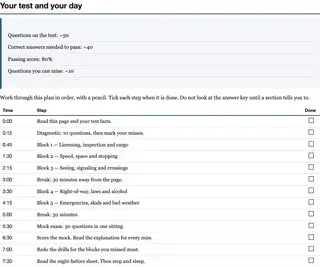
Florida Permit & CDL Tests: 1‑Day Study Plans
Our own study plan. Its questions are free here; its lessons are only in this plan.
- Weeks awayGet the pack — $4.99
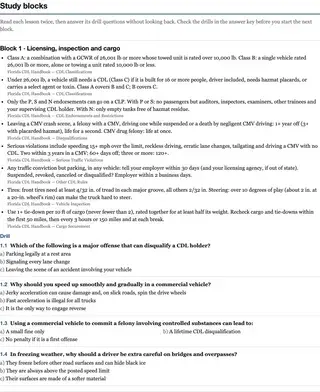
Florida Practice Test Pack — 2026 Printable Edition
Our own printable edition — nobody paid us to show it to you, and everything in it is free to read here too.
- One-time purchase
- Instant download
- 14-day refund
Study questions with answers
10 sample Signals & Pavement Markings questions with the correct answer, a short explanation, and the official handbook reference. Read through them, then take the quiz above.
Show all 10 questions with answers
1. A car behind you wants to pass and, from your high seat, the road ahead looks clear. Should you wave the driver around?
Correct answer: No, never signal another driver that passing is safe
Waving someone past makes you responsible for whatever happens next, and a resulting crash can be blamed on you at enormous cost. Let other drivers decide for themselves when to pass.
2. Objects seen in a convex ('spot') mirror on a truck appear:
Correct answer: Smaller and farther away than they really are
Convex mirrors show a wider area but make everything look smaller and farther away than it really is. A vehicle in a convex mirror is closer and larger than it appears.
Source: Florida CDL Handbook — Seeing
3. A white line is painted across the pavement just ahead of a set of railroad tracks. What is a stopping driver expected to do about it?
Correct answer: Keep the front of the vehicle behind it while stopped
That painted line marks the safe place to wait. A school bus, for one, has to hold its front bumper behind the line while the driver looks and listens for a train.
4. You are about to slow down where drivers behind may not expect it. How can you warn them?
Correct answer: Tap the brake pedal to flash your brake lights and use flashers if needed
Tap the brake pedal a few times to flash your brake lights, and use the four-way flashers if you must travel much slower than surrounding traffic. This warns drivers who might otherwise close in fast.
5. When is it best for a commercial driver to use the horn?
Correct answer: Only when needed to warn others and help avoid a crash
The horn can startle other drivers or road users and cause a wrong reaction, such as a pedestrian stepping the wrong way. Use it only when it is needed to warn someone of danger.
6. The signals at a gated crossing begin flashing as you approach. When may you drive across?
Correct answer: After the gates rise fully and the lights go dark, if the way is clear
Stop before the gate starts down and stay put. Only when the arms are back up, the flashing has ended and you have checked every set of rails should you move ahead.
7. How often should a commercial driver check the mirrors while driving?
Correct answer: Regularly, and especially before lane changes and turns
Check your mirrors regularly to track traffic beside and behind you, especially before changing lanes, turning, merging, or slowing. Remember that mirrors leave blind spots you still must watch.
Source: Florida CDL Handbook — Seeing
8. Which sequence of lights should a school bus driver use when arriving at and stopping for a student pick-up?
Correct answer: Alternating amber lights well before the stop, then alternating red lights with the stop arm out
The amber pair warns following traffic that a stop is coming, roughly two hundred feet or several seconds ahead. The red pair and the extended stop arm come on only once the bus has halted and traffic is a safe distance back.
9. When should a commercial driver signal before turning or changing lanes?
Correct answer: Early, and keep signaling until the maneuver is complete
Signal early and keep the signal on through the maneuver so others have plenty of warning. A large vehicle moves and stops slowly, so nearby drivers need extra time to react.
10. At dawn, at dusk, or in rain, turning on your headlights helps mainly by:
Correct answer: Making your large vehicle easier for others to see
In dim light or bad weather, low-beam headlights make your large vehicle far more visible to others. Being seen matters as much as seeing, so use headlights — not just daytime running lights — when visibility drops.
More CDL — General Knowledge topics
Practice Signals & Pavement Markings in another state
Every Florida question is written from the official Florida driver handbook and checked against its current edition. DMV Test Free is a free, independent study resource — not affiliated with any DMV or government agency. About DMV Test Free
Study offline
Florida Practice Test Pack — 2026 Printable Edition
$4.99 · One-time purchase. Instant download.
Our own printable edition — nobody paid us to show it to you, and everything in it is free to read here too.