Florida Car / Permit practice
Florida Car / Permit: Speed & Space Management practice test
Choosing a safe speed, keeping a space cushion, adjusting for weather and traffic, and understanding stopping distance.
Content reviewed against official driver handbooks · August 12, 2026
12 questions · pass with 10 correct. You get instant feedback and an explanation after every answer.
When is your test?
- This weekGet the plan — $4.99
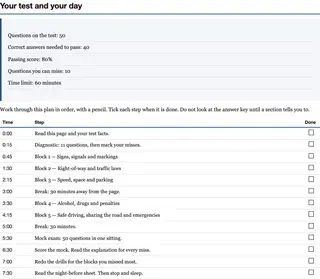
Florida Permit & CDL Tests: 1‑Day Study Plans
Our own study plan. Its questions are free here; its lessons are only in this plan.
- Weeks awayGet the pack — $4.99
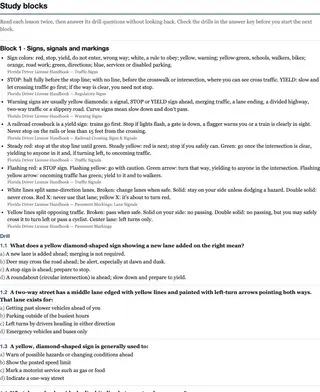
Florida Practice Test Pack — 2026 Printable Edition
Our own printable edition — nobody paid us to show it to you, and everything in it is free to read here too.
- One-time purchase
- Instant download
- 14-day refund
Study questions with answers
12 sample Speed & Space Management questions with the correct answer, a short explanation, and the official handbook reference. Read through them, then take the quiz above.
Show all 12 questions with answers
1. Driving much slower than the traffic around you on a highway is:
Correct answer: Dangerous and can be illegal, because it blocks the normal flow of traffic
Going too slowly can be as dangerous as speeding—it forces others to brake and pass. Unless conditions require a lower speed, keep pace with traffic without exceeding the limit, and let faster traffic pass.
2. Which three lengths added together make up total stopping distance?
Correct answer: Perception distance, reaction distance and braking distance
First your eyes and brain register the hazard, then your foot travels to the pedal, and finally the brakes bring the car down to a halt. Those three lengths together are how far you cover before stopping.
3. Which statement about speeding in a Florida construction zone is true?
Correct answer: Speeding fines are doubled in a construction zone
Florida doubles the fine for a speeding violation in a school zone or construction zone. Speed limits still apply there, so slow down and obey the posted limits.
4. In fair weather and light traffic, what is the smallest gap you should keep behind the vehicle in front?
Correct answer: Four seconds
Count off the seconds between the car ahead passing a fixed object such as a pole and your own front bumper reaching it. Fewer than four seconds means you are too close, and poor conditions call for more.
Source: Florida Driver License Handbook — Following Distances
5. What is the correct way to leave an expressway?
Correct answer: Signal, move into the exit lane, and do your slowing on the exit ramp
Signal early and move into the exit lane, then do your slowing on the deceleration ramp. Braking in the through lane forces the drivers behind you to slow suddenly.
Source: Florida Driver License Handbook — Expressway Driving
6. Is there a legal cushion in Florida that lets you drive roughly 10 MPH quicker than the posted limit?
Correct answer: No — a citation can follow any speed above the limit
The idea of a speeding cushion is a myth. An officer may cite you for any reading over the posted number, and overtaking another vehicle grants no exemption either.
7. On a four-lane road you come upon a tow truck halted on the shoulder with its warning lights going, but traffic beside you makes changing lanes impossible. You must:
Correct answer: Slow to 20 MPH below the posted limit
The Move Over Law asks you to clear the lane next to a stopped emergency, tow, utility or maintenance vehicle. Where traffic makes that unsafe, the alternative is to drop 20 MPH under the posted limit as you go past.
8. Even when you are driving at the posted speed limit, Florida's 'basic speed law' says you must:
Correct answer: Slow to a safe speed for the current road, weather, and traffic
The posted limit is the maximum for ideal conditions. In rain, fog, heavy traffic, or on curves, the law requires you to slow to a speed that is safe for the conditions.
9. How does higher speed affect the distance your vehicle needs to stop?
Correct answer: It greatly increases the total stopping distance
Total stopping distance combines reaction distance and braking distance. As speed rises, both grow, so it takes much farther to stop at higher speeds.
Source: Florida Driver License Handbook — Speed and Stopping Distance
10. No speed sign is posted anywhere along a residential street. Which limit applies to you?
Correct answer: 30 MPH
Where nothing is posted, Florida sets 30 MPH through business and residential areas. School zones drop to 20 MPH, while ordinary streets and highways run up to 55 MPH.
11. What is the correct way to enter an expressway from an on-ramp?
Correct answer: Use the ramp to reach the speed of traffic, then merge into a gap
Use the acceleration lane to reach the speed of expressway traffic, signal, find a gap, and merge smoothly. Entering too slowly forces others to brake for you.
Source: Florida Driver License Handbook — Expressway Driving
12. If you double how fast you are driving, the force with which your car would strike something becomes:
Correct answer: Four times as great
Striking power climbs much faster than the speedometer does. Twice the speed gives four times the force, and three times the speed gives nine times as much.
More Car / Permit topics
Practice Speed & Space Management in another state
Every Florida question is written from the official Florida driver handbook and checked against its current edition. DMV Test Free is a free, independent study resource — not affiliated with any DMV or government agency. About DMV Test Free
Study offline
Florida Practice Test Pack — 2026 Printable Edition
$4.99 · One-time purchase. Instant download.
Our own printable edition — nobody paid us to show it to you, and everything in it is free to read here too.