California Car / Permit practice
California Car / Permit: Alcohol & Drugs practice test
Blood alcohol limits, zero-tolerance and implied-consent laws, and how alcohol and drugs — legal or not — affect your driving.
Content reviewed against official driver handbooks · August 12, 2026
12 questions · pass with 10 correct. You get instant feedback and an explanation after every answer.
Choose your level
Up to 20 questions on this topic, with feedback after every answer.
When is your test?
- This weekGet the plan — $4.99
California Permit & CDL Tests: 1‑Day Study Plans
Our own study plan. Its questions are free here; its lessons are only in this plan.
- Weeks awayGet the pack — $4.99
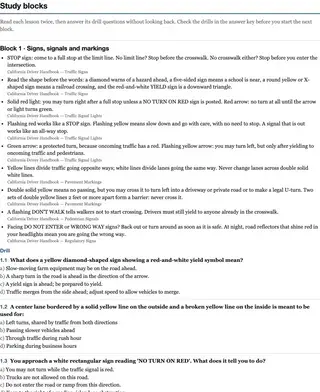
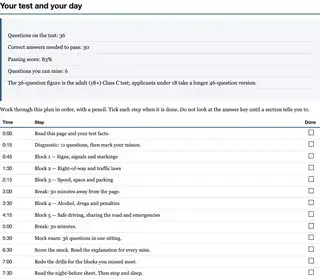
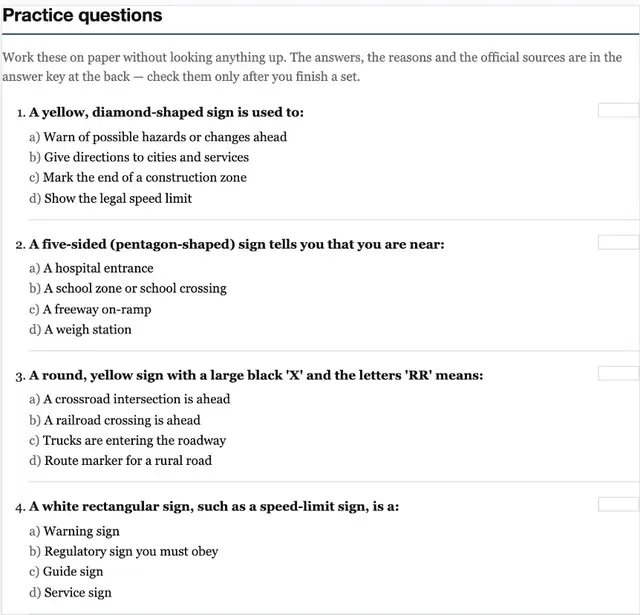
California Practice Test Pack — 2026 Printable Edition
Our own printable edition — nobody paid us to show it to you, and everything in it is free to read here too.
- One-time purchase
- Instant download
- 14-day refund
Study questions with answers
12 sample Alcohol & Drugs questions with the correct answer, a short explanation, and the official handbook reference. Read through them, then take the quiz above.
Show all 12 questions with answers
1. According to the BAC table in the California handbook, what lowers your blood alcohol concentration after you drink?
Correct answer: Only the passage of time
The handbook's BAC table says to subtract 0.01% for each 40 minutes that pass between drinks, so the passage of time is what lowers your BAC. Nothing in it credits coffee, a cold shower, or a meal. The handbook adds that a single drink can already affect your driving.
2. In California, it is illegal to have an open container of alcohol:
Correct answer: In the passenger area of the vehicle
It is illegal to keep an open container of alcohol where passengers sit, and that includes the glove box. A sealed, unopened container is fine. If a container is open, it must go in the trunk or somewhere passengers do not sit. It does not matter whether the driver is drinking from it.
3. Under California's "zero tolerance" law, a driver under 21 may not drive with a BAC at or above:
Correct answer: 0.01%
Drivers under 21 may not drive with a BAC of 0.01% or higher. This is far stricter than the 0.08% limit for adults over 21, so one drink can put a young driver over it. The 0.04% figure applies to commercial drivers and drivers carrying passengers for hire, not to people under 21 in general.
4. By driving in California, you have already agreed ("implied consent") to:
Correct answer: Chemical testing if lawfully arrested for DUI
Simply by driving in California you agree to a breath, blood, or urine test when an officer suspects DUI. Refusing means DMV will suspend or revoke your driving privilege for a year. That consent covers chemical testing for DUI, not random vehicle searches and not giving up your right to a lawyer.
5. A driver transporting a passenger for hire, such as a rideshare or taxi passenger, may not drive with a BAC at or above:
Correct answer: 0.04%
If you are driving a passenger for hire, such as a taxi or rideshare passenger, it is illegal to drive with a BAC of 0.04% or higher. This is the same limit that applies when you drive a vehicle that needs a commercial license. The ordinary 0.08% limit is for other adults over 21, and 0.01% for drivers under 21.
Source: California Driver Handbook — BAC Limits
6. If you refuse a lawfully requested chemical test after being arrested for DUI, DMV will:
Correct answer: Suspend or revoke your driving privilege for one year
If you refuse a chemical test requested by a law enforcement officer, DMV will suspend or revoke your driving privilege for a year. Refusing does not avoid a penalty. By driving in California you have already consented to a breath, blood, or urine test if the officer suspects DUI, so the refusal itself carries the consequence.
Source: California Driver Handbook — DUI Arrests
7. A first-time DUI conviction for a driver 21 or older in California can result in:
Correct answer: Fines, possible jail, a DUI program, and license suspension
A DUI conviction brings serious penalties: DMV will suspend or revoke your driving privilege for a year, and you must finish a DUI program. You may also be fined and sentenced to up to six months in jail, and your vehicle may be impounded. A first offense does not get just a warning or a small fine.
8. For a driver with a commercial driver license (CDL) operating a commercial vehicle, the illegal BAC level is:
Correct answer: 0.04%
It is illegal to drive a vehicle that requires a commercial driver's license with a BAC of 0.04% or higher. That is stricter than the 0.08% limit for most adults. The same 0.04% limit applies when you are driving a passenger for hire. The 0.01% figure applies to drivers under 21 and anyone on DUI probation.
9. Driving after using cannabis (marijuana) in California is:
Correct answer: Illegal if it impairs your driving, the same as alcohol
California's DUI laws apply to drugs as well as alcohol, so driving after using anything that affects your ability to drive safely is illegal. The handbook is also strict about cannabis in a vehicle: you may not smoke or eat it while driving, and an open container must stay in the trunk or where passengers do not sit.
10. For a driver of any age who is on DUI probation, it is illegal to drive with a BAC at or above:
Correct answer: 0.01%
If you are on DUI probation, it is illegal to drive with a BAC of 0.01% or higher, at any age. The 0.04% limit applies to commercial vehicles and passengers for hire, and 0.08% applies to adults over 21 who are not on probation. Being on probation lowers your limit to nearly zero.
Source: California Driver Handbook — BAC Limits
11. Prescription and over-the-counter medicines:
Correct answer: Can impair driving, and driving while impaired by them is illegal
Prescription and over-the-counter medicines can affect your ability to drive safely, and the law treats them like any other drug. It is illegal to drive after taking any drug that impairs you, and you can be arrested for DUI. Read labels and learn a medicine's effects first, because being legal to buy does not make it safe to drive on.
12. For a driver 21 years or older, it is illegal to drive with a blood alcohol concentration (BAC) at or above:
Correct answer: 0.08%
If you are over 21, driving with a blood alcohol concentration of 0.08% or more is illegal. Lower numbers apply to drivers under 21, those on DUI probation, commercial drivers, and drivers carrying passengers for hire. You can also be convicted of DUI at a lower BAC, because impairment itself is what matters.
More Car / Permit topics
Practice Alcohol & Drugs in another state
Every California question is written from the official California driver handbook and checked against its current edition. DMV Test Free is a free, independent study resource — not affiliated with any DMV or government agency. About DMV Test Free
Study offline
California Practice Test Pack — 2026 Printable Edition
$4.99 · One-time purchase. Instant download.
Our own printable edition — nobody paid us to show it to you, and everything in it is free to read here too.