California Car / Permit practice
California Car / Permit: Traffic Laws practice test
Speed limits, turning and signaling rules, headlight and seat-belt requirements, and the everyday laws every driver must follow.
Content reviewed against official driver handbooks · August 12, 2026
18 questions · pass with 14 correct. You get instant feedback and an explanation after every answer.
When is your test?
- This weekGet the plan — $4.99
California Permit & CDL Tests: 1‑Day Study Plans
Our own study plan. Its questions are free here; its lessons are only in this plan.
- Weeks awayGet the pack — $4.99
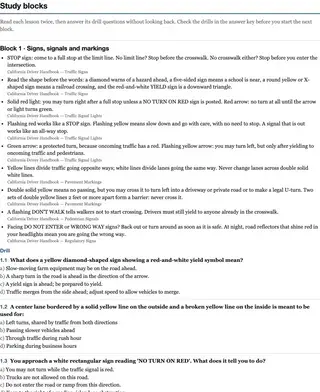
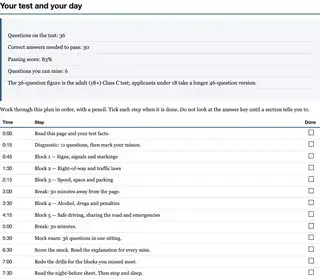
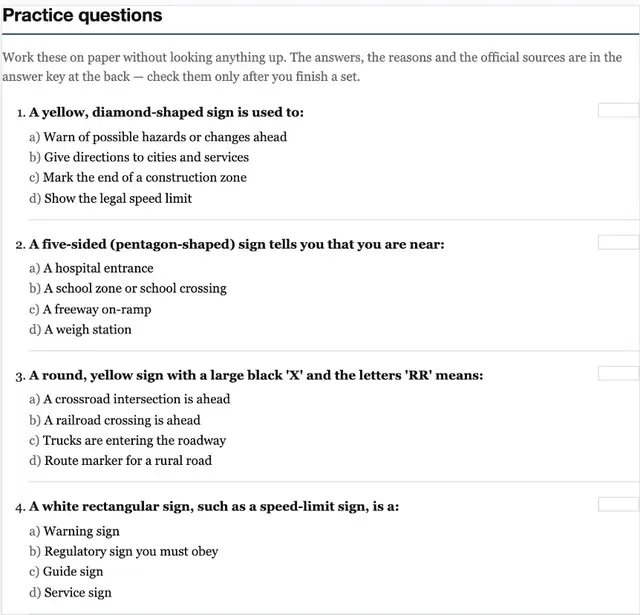
California Practice Test Pack — 2026 Printable Edition
Our own printable edition — nobody paid us to show it to you, and everything in it is free to read here too.
- One-time purchase
- Instant download
- 14-day refund
Study questions with answers
12 sample Traffic Laws questions with the correct answer, a short explanation, and the official handbook reference. Read through them, then take the quiz above.
Show all 12 questions with answers
1. Under California's hands-free law, a driver may operate a cell phone mounted to the dash or windshield only by:
Correct answer: Using a single tap or swipe of a finger
A phone mounted on the windshield, dashboard, or center console must not block your view, and you may operate it only with a single swipe or touch. Typing a full address, holding it, or watching video takes your eyes and attention off the road. Adults should use phones only in hands-free mode, and only when necessary.
Source: California Driver Handbook — Distracted Driving / Cell Phone Laws
2. What is the speed limit when crossing a blind intersection where you cannot see clearly in each direction?
Correct answer: 15 mph
A blind intersection is one with no stop sign on any corner. When something blocks your view, creep forward until you can see, and keep your speed at or below 15 mph. Treating it like an ordinary street, where 25 mph might apply, is wrong, since a blind intersection has its own lower limit.
3. Unless otherwise posted, the speed limit when passing a school while children are present is:
Correct answer: 25 mph
Near a school, the limit is 25 mph if you are within 500 feet of the school and kids are outside or crossing. Some school zones post limits as low as 15 mph. You should not assume a higher speed, such as 35 mph, because the presence of children is what triggers the lower limit.
4. What does California's "Basic Speed Law" require of drivers?
Correct answer: You must never drive faster than is safe for current conditions
California's Basic Speed Law says you may never drive faster than is safe for current road conditions. That holds whatever the posted limit says. Weather, traffic, the road surface, and pedestrians can all make a lower speed the safe one, so staying at the limit is not always enough, and the law applies on every road, not just freeways.
5. California law limits how far cargo may extend past your vehicle's fenders. Beyond the right fenders, cargo may extend no more than:
Correct answer: 6 inches
A load may not extend past the fenders on the left side at all, and no more than 6 inches past the fenders on the right side. Cargo sticking out more than 4 feet from the rear bumper must display a 12-inch red or fluorescent orange flag. Securing the load does not remove these limits on how far it can stick out.
Source: California Driver Handbook — Vehicle Loads
6. Operating a vehicle with a license plate that is illegible or has been altered is:
Correct answer: Illegal
You may not drive a vehicle with an illegible license plate, and you may not alter a license plate in any way. Either one makes driving the vehicle illegal in California, so the idea that it is allowed in some cases is wrong. Keep your plate readable and unchanged.
Source: California Driver Handbook — Other Roadway Requirements
7. Unless otherwise posted, what is the speed limit in a residential or business district?
Correct answer: 25 mph
In a business or residential district, the speed limit is 25 mph unless a sign says otherwise. That is the default, so you do not need a posted sign to be bound by it. Slower limits such as 15 mph apply only in specific places like alleys or blind intersections, not district streets in general.
8. At a red light, a right turn is:
Correct answer: Allowed after a complete stop, unless a sign prohibits it
You may turn right on a red light after a complete stop at the limit line, as long as no NO TURN ON RED sign is posted. Yield to pedestrians and turn only when it is safe. Rolling through without stopping is not allowed. Also remember that a red arrow is different: you may not turn right on one.
9. An alley is defined as a road no wider than 25 feet used to reach the side or rear of buildings. Unless otherwise posted, the speed limit in an alley is:
Correct answer: 15 mph
An alley is a road no more than 25 feet wide that gives access to the back or side of buildings. Its speed limit is 15 mph. Do not confuse the 25-foot width of the alley with its limit: the handbook gives 25 mph to business and residential districts, not to alleys.
Source: California Driver Handbook — Alleys
10. Unless otherwise posted, what is the maximum speed limit on most two-lane undivided highways in California?
Correct answer: 55 mph
Unless a different limit is posted, the maximum speed on a two-lane undivided highway is 55 mph. The same 55 mph limit applies to vehicles towing trailers. The ideal maximum on most other California highways is 65 mph, so that figure does not fit a two-lane undivided road, and 45 mph is not the default anywhere here.
11. Before turning, you must signal continuously during the last:
Correct answer: 100 feet before the turn
Signal at least 100 feet before you turn, so other drivers, bicyclists, and pedestrians have time to react. Starting your signal only as you begin the turn gives them too little warning. You should also signal before every lane change, and keep the signal on until you finish, then turn it off once it is no longer needed.
12. In a highway construction or maintenance zone where workers are present, fines for traffic violations are generally:
Correct answer: Doubled
Traffic fines are doubled in highway construction or maintenance zones whenever workers are there, and also in designated Safety Enhanced-Double Fine Zones. Fines in a work zone can reach $1,000 or more. So fines are not reduced or waived, and they are not the same as elsewhere. Slow down and obey the signs and flaggers.
Source: California Driver Handbook — Work Zones / Construction Areas
More Car / Permit topics
Practice Traffic Laws in another state
Every California question is written from the official California driver handbook and checked against its current edition. DMV Test Free is a free, independent study resource — not affiliated with any DMV or government agency. About DMV Test Free
Study offline
California Practice Test Pack — 2026 Printable Edition
$4.99 · One-time purchase. Instant download.
Our own printable edition — nobody paid us to show it to you, and everything in it is free to read here too.