California Car / Permit practice
California Car / Permit: Parking & Stopping practice test
Legal and illegal parking, colored curbs, distances from hydrants and crossings, and how to park safely on hills.
Content reviewed against official driver handbooks · August 12, 2026
12 questions · pass with 10 correct. You get instant feedback and an explanation after every answer.
Choose your level
Up to 20 questions on this topic, with feedback after every answer.
When is your test?
- This weekGet the plan — $4.99
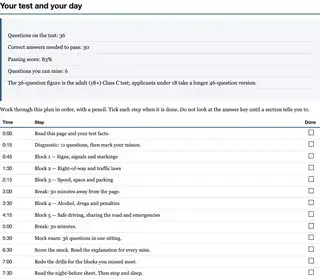
California Permit & CDL Tests: 1‑Day Study Plans
Our own study plan. Its questions are free here; its lessons are only in this plan.
- Weeks awayGet the pack — $4.99
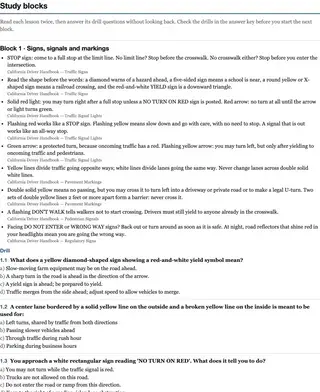
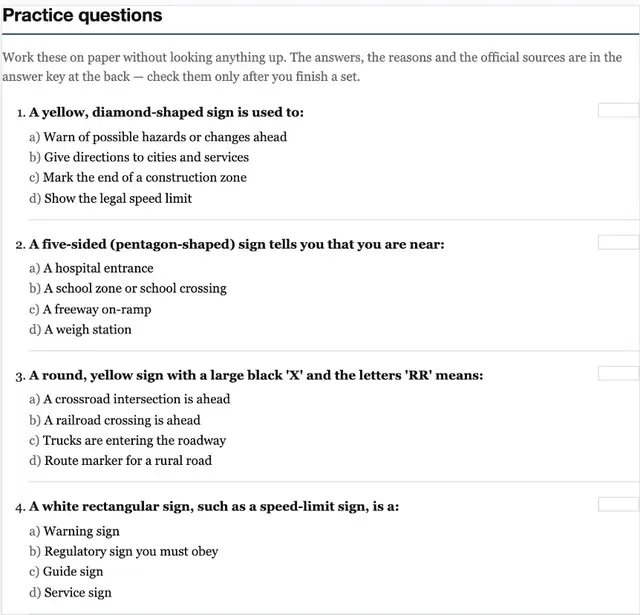
California Practice Test Pack — 2026 Printable Edition
Our own printable edition — nobody paid us to show it to you, and everything in it is free to read here too.
- One-time purchase
- Instant download
- 14-day refund
Study questions with answers
12 sample Parking & Stopping questions with the correct answer, a short explanation, and the official handbook reference. Read through them, then take the quiz above.
Show all 12 questions with answers
1. You may not park within how many feet of a fire hydrant?
Correct answer: 15 feet
Never park within 15 feet of a fire hydrant. The handbook also bars parking within 15 feet of a fire station driveway. Ten feet or less is too close under this rule. Do not confuse it with the 20-foot distance that applies near a crosswalk, since the two numbers come from different rules.
2. Under California's "daylighting" law, you generally may not stop or park within 20 feet of:
Correct answer: The approach side of a crosswalk
You may not park within 20 feet of a marked or unmarked crosswalk, or within 15 feet when the crosswalk has a curb extension. This keeps pedestrians easy to see, and it applies even where the curb is not painted red. A bus or an on-ramp is not what triggers this distance.
Source: California Driver Handbook — Parking / Daylighting Law
3. You may not park within how many feet of a sidewalk wheelchair ramp for disabled persons?
Correct answer: 3 feet
Never park within three feet of a sidewalk ramp built for disabled persons, and never park on or in front of a curb cut that gives wheelchair access to the sidewalk. The distance is three feet, not 10 or 15. The rule exists so the ramp stays clear for people who need it.
Source: California Driver Handbook — Illegal Parking
4. When you park facing downhill next to a curb, you should turn your front wheels:
Correct answer: Toward the curb
When you park facing downhill next to a curb, turn your front wheels into the curb, toward the right side of the road, and set the parking brake. If the vehicle rolls, the curb stops it. Wheels turned away from the curb is the uphill rule, so the direction matters and does not change with preference.
5. A yellow-painted curb means you may stop only long enough to:
Correct answer: Load or unload passengers or freight
A yellow curb is for loading and unloading passengers and freight. Stay no longer than the posted time, and if you drive a noncommercial vehicle you usually must stay with it. Waiting while a passenger shops, parking overnight, or using a disabled placard are not what yellow curbs allow. Blue curbs are for placards.
6. A blue-painted curb is reserved for:
Correct answer: Parking for people with disabilities who have a placard
A blue curb is reserved for a disabled person, or a driver carrying one, who displays a special placard or license plate. Deliveries are for yellow curbs, and quick passenger drop-off is for white ones. Parking in the crosshatched area next to a designated disabled space is also against the rules.
7. A red-painted curb means:
Correct answer: No stopping, standing, or parking
A red curb means no stopping, standing, or parking. The single exception is a red zone marked for buses only, where buses may stop. Loading is not allowed there, which is what yellow and white curbs are for. A limited parking time belongs to green curbs, and disabled parking belongs to blue ones.
8. A green-painted curb means you may park there:
Correct answer: For a limited time, as posted
A green curb allows parking for a limited time only. The limit may appear on a sign or be painted on the curb. It is not unlimited parking, and it is not restricted to disabled placard holders or to loading freight. Yellow curbs are the ones for loading and unloading passengers and freight, and blue curbs are for placards.
Source: California Driver Handbook — Colored Curbs
9. A white-painted curb means you may stop only long enough to:
Correct answer: Pick up or drop off passengers or mail
A white curb lets you stop just briefly, to let passengers on or off. It is not a place to wait for a space or to park for a set time, because those uses belong to other colors. Yellow curbs are the ones for loading or unloading passengers and freight.
10. A vehicle left stopped, parked, or standing on a freeway for more than how many hours may be removed?
Correct answer: 4 hours
A vehicle that sits stopped, parked, or standing on a freeway longer than four hours may be removed. Parking or stopping on a freeway is generally prohibited in the first place, except in an emergency, when a law enforcement officer requires it, or where it is specifically permitted. One hour or 24 hours is not the cutoff.
Source: California Driver Handbook — Illegal Parking
11. When you parallel park, your tires should be within how far of the curb?
Correct answer: 18 inches
When you parallel park, your vehicle should end up parallel to the curb and within 18 inches of it. You begin turning the wheel away from the curb once your rear wheel is within 18 inches. Three feet is the length you need to spare in the space, not the gap you leave from the curb.
12. When you park facing uphill next to a curb, you should turn your front wheels:
Correct answer: Away from the curb
When parking uphill next to a curb, turn your front wheels away from the curb, toward the center of the road. Let the vehicle roll back a few inches so the front wheel gently touches the curb, and set the parking brake. Turning toward the curb is the downhill rule, so check the slope first.
More Car / Permit topics
Practice Parking & Stopping in another state
Every California question is written from the official California driver handbook and checked against its current edition. DMV Test Free is a free, independent study resource — not affiliated with any DMV or government agency. About DMV Test Free
Study offline
California Practice Test Pack — 2026 Printable Edition
$4.99 · One-time purchase. Instant download.
Our own printable edition — nobody paid us to show it to you, and everything in it is free to read here too.