California Car / Permit practice
California Car / Permit: Right-of-Way practice test
Who goes first at intersections, four-way stops, roundabouts, and crosswalks, and how to yield to pedestrians and emergency vehicles.
Content reviewed against official driver handbooks · August 12, 2026
15 questions · pass with 12 correct. You get instant feedback and an explanation after every answer.
Choose your level
Up to 20 questions on this topic, with feedback after every answer.
When is your test?
- This weekGet the plan — $4.99
California Permit & CDL Tests: 1‑Day Study Plans
Our own study plan. Its questions are free here; its lessons are only in this plan.
- Weeks awayGet the pack — $4.99
California Practice Test Pack — 2026 Printable Edition
Our own printable edition — nobody paid us to show it to you, and everything in it is free to read here too.
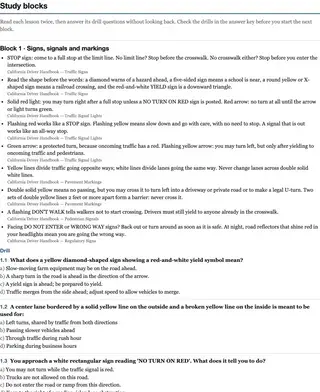
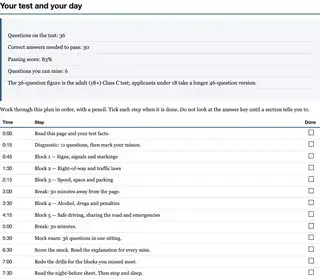
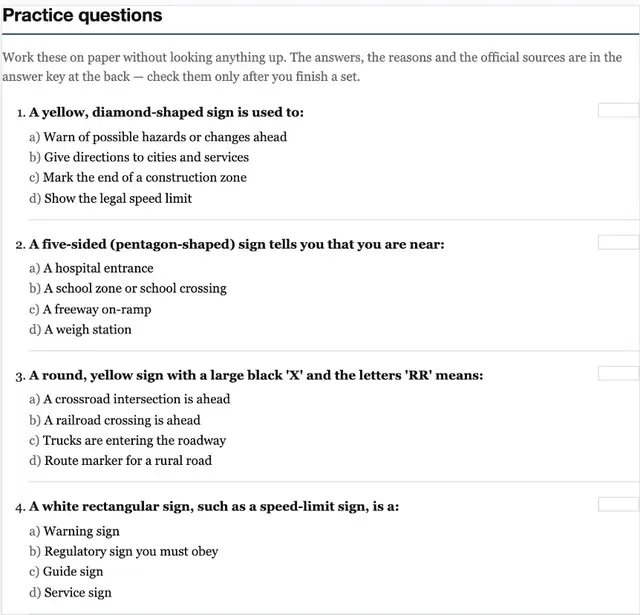
- One-time purchase
- Instant download
- 14-day refund
Study questions with answers
12 sample Right-of-Way questions with the correct answer, a short explanation, and the official handbook reference. Read through them, then take the quiz above.
Show all 12 questions with answers
1. Two vehicles meet on a steep, narrow mountain road where neither can pass. Which vehicle has the right-of-way?
Correct answer: The vehicle facing uphill
When two vehicles meet on a narrow, steep road with no room to pass, the vehicle facing uphill has the right-of-way. The downhill driver has more control when backing up the hill, so that driver backs up until the uphill vehicle can pass. Size and arrival time do not decide it.
Source: California Driver Handbook — Mountain Roads
2. A pedestrian steps into a crosswalk against the signal, directly in your path. You should:
Correct answer: Slow, stop if needed, and avoid the pedestrian
Pedestrians always have the right-of-way, and drivers must yield even when a DON'T WALK signal is flashing. When someone is crossing, you need to be careful, slow down, or stop so they can finish. Honking and driving on, or assuming they will get out of your way, puts them at risk.
Source: California Driver Handbook — Pedestrians / Right-of-Way
3. At an open intersection with no stop signs or signals, you must yield to a vehicle that:
Correct answer: Has already entered the intersection or is on your right
At an intersection with no signs or signals, the vehicle that arrives first has the right-of-way. If you and another vehicle, bicyclist, or pedestrian arrive at the same time, give way to the one on your right. Size does not matter, and a vehicle waiting behind you has no claim on the intersection.
4. When you are about to enter a road from a driveway or alley, you must:
Correct answer: Yield to vehicles and pedestrians already there
When entering a road from a driveway or alley, you are entering traffic, so you must go carefully and give way to traffic already in the lanes. Pedestrians always have the right-of-way too. Pulling out quickly or sounding the horn does not give you priority, and you should not expect other drivers to slow for you.
5. It is against the law to enter an intersection, even on a green light, if:
Correct answer: You cannot get completely across before the light turns red
Even with a green light, you may not enter an intersection unless you can get completely across before the light turns red. Stopping or blocking the intersection when there is not enough space is against the law. Another car on the street, a larger vehicle, or a planned turn does not make entering illegal.
Source: California Driver Handbook — Right-of-Way Rules
6. When you make a right turn at an intersection, in addition to checking for pedestrians in the crosswalk, you must also watch for:
Correct answer: Motorcyclists and bicyclists riding alongside you
When you turn right, check for pedestrians in the crosswalk and also for motorcycles and bicycles riding next to you, between your vehicle and the curb. They can be in your blind spot, so look over your right shoulder. Having the right-of-way does not remove your duty to check, and cars from the left are not the only risk.
Source: California Driver Handbook — Right-of-Way Rules
7. At a solid green traffic signal light, you may proceed, but you must still:
Correct answer: Yield to any vehicle, bicyclist, or pedestrian still in the intersection
A green light means go, but you must still stop for any vehicle, bicyclist, or pedestrian that is in the intersection. Go only if there is room to do so without endangering oncoming traffic. Rushing through or speeding up to clear the intersection is not allowed, and you do not need a green arrow just to go straight.
Source: California Driver Handbook — Traffic Signal Lights
8. At a four-way stop where vehicles arrive at different times, who has the right-of-way?
Correct answer: The vehicle that arrived and stopped first
At a four-way stop where every corner has a stop sign, the vehicle that arrives first has the right-of-way, after everyone stops. Size, speed, and direction of travel do not decide it. Only when vehicles arrive together do you yield to the one on your right. Never assume another driver will give you the right-of-way.
9. When an emergency vehicle approaches with its siren and flashing lights on, you should:
Correct answer: Pull to the right edge of the road and stop
When an emergency vehicle approaches with a siren and red lights, pull over to the right edge of the road and stop, staying there until it has passed. Failing to pull over can earn you a ticket. If you are already inside an intersection, continue through it, then move to the right once that is safe and stop.
10. When you enter a roundabout (traffic circle), you must:
Correct answer: Yield to traffic already in the circle
In a roundabout you must slow down and yield to all traffic already in the circle, then enter heading right when there is a big enough gap. Traffic travels counterclockwise, so driving clockwise is wrong. You do not wait for a green arrow, and being on the right gives you no priority over cars already circulating.
11. An emergency vehicle with lights and siren approaches while you are already inside a roundabout. You should:
Correct answer: Continue to your exit, then pull over and stop
The handbook says not to stop inside a roundabout. If you are in an intersection when an emergency vehicle comes, you continue through it, then drive to the right when it is safe and stop. Apply the same idea here: keep moving to your exit, then pull over, rather than stopping in the circle or reversing.
Source: California Driver Handbook — Roundabouts / Emergency Vehicles
12. At a four-way stop, if two vehicles arrive at exactly the same time, who should yield?
Correct answer: The driver on the left yields to the driver on the right
When two vehicles reach a four-way stop at the same time, the driver on the left yields to the driver on the right. Vehicle size and who signaled first do not decide it. The general rule is that you give the right-of-way to the vehicle, bicyclist, or pedestrian on your right when you arrive together.
More Car / Permit topics
Practice Right-of-Way in another state
Every California question is written from the official California driver handbook and checked against its current edition. DMV Test Free is a free, independent study resource — not affiliated with any DMV or government agency. About DMV Test Free
Study offline
California Practice Test Pack — 2026 Printable Edition
$4.99 · One-time purchase. Instant download.
Our own printable edition — nobody paid us to show it to you, and everything in it is free to read here too.