California Car / Permit practice
California Car / Permit: Sharing the Road practice test
Driving safely around motorcycles, bicycles, large trucks, pedestrians, and school buses — and knowing who has the right of way.
Content reviewed against official driver handbooks · August 12, 2026
15 questions · pass with 12 correct. You get instant feedback and an explanation after every answer.
Choose your level
Up to 20 questions on this topic, with feedback after every answer.
When is your test?
- This weekGet the plan — $4.99
California Permit & CDL Tests: 1‑Day Study Plans
Our own study plan. Its questions are free here; its lessons are only in this plan.
- Weeks awayGet the pack — $4.99
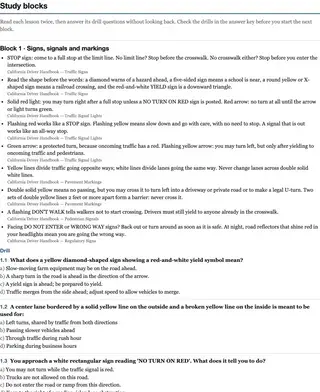
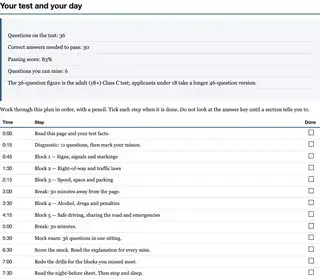
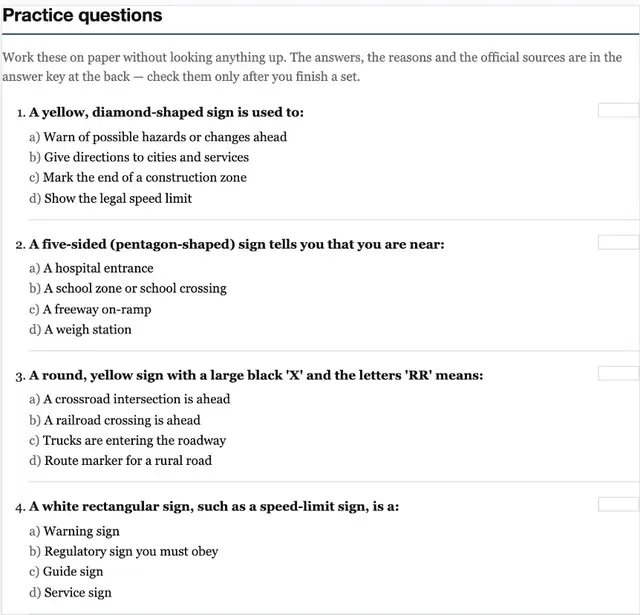
California Practice Test Pack — 2026 Printable Edition
Our own printable edition — nobody paid us to show it to you, and everything in it is free to read here too.
- One-time purchase
- Instant download
- 14-day refund
Study questions with answers
12 sample Sharing the Road questions with the correct answer, a short explanation, and the official handbook reference. Read through them, then take the quiz above.
Show all 12 questions with answers
1. A large truck or bus is making a right turn in front of you and swings wide to the left first. You should:
Correct answer: Stay back and never squeeze to the right of the truck
Because a long vehicle's rear wheels follow a shorter path than its front wheels, trucks and buses often swing wide to complete a turn, and may even appear to be going the opposite way. Stay back and wait. Trying to pass on the right between the truck and the curb, or speeding around it, puts you in its path.
Source: California Driver Handbook — Sharing the Road with Trucks
2. When passing a bicyclist traveling in the same direction, you must give a clearance of at least:
Correct answer: 3 feet
When you cannot move over to pass a bicyclist, leave a gap of three feet or more beside the bicyclist. If you cannot give three feet, do not pass until you can. One foot is not enough, and there is a required distance, so you cannot just pass as closely as you like.
Source: California Driver Handbook — Sharing the Road with Bicyclists
3. The vehicle in the lane next to you comes to a stop at a marked crosswalk. Before passing it, you should:
Correct answer: Slow or stop, because a pedestrian may be crossing
Do not pass a vehicle that is stopped at a crosswalk. The driver may be yielding to a pedestrian you cannot see yet, and passing it puts that person at risk. Slow down or stop until you are sure the crosswalk is clear. Assuming the other driver stopped by mistake, or sounding your horn, does not make passing safe.
Source: California Driver Handbook — Pedestrians / Crosswalks
4. A pedestrian who is using a white cane or a guide dog is:
Correct answer: Always entitled to the right-of-way
A pedestrian using a guide dog or white cane is partially or totally blind and has the right-of-way at all times. Do not stop in the middle of a crosswalk, which could push them into traffic, and do not honk at them. Signals do not limit this right, so you must wait for them to cross.
5. When you are near a motorcyclist, you should remember that in California, motorcyclists:
Correct answer: May legally split lanes, so watch for them
Motorcyclists have the same rights as other drivers, and it is legal to share lanes with them, which is called lane splitting. Motorcycles are small and easily disappear into blind spots, so check your mirrors before changing lanes. They are not required to ride on the shoulder, and you should never pass one within the same lane.
Source: California Driver Handbook — Sharing the Road with Motorcyclists
6. Large trucks have big blind spots (sometimes called "No-Zones"). To stay safe, you should:
Correct answer: Avoid lingering beside or close behind the truck
Large trucks have big blind spots called No Zones, where your car can vanish from sight. When the truck's side mirrors are out of your view, its driver cannot see you either. Stay off a truck's tail, and do not linger beside it. Trucks also take longer to stop, so never assume one can brake as fast as a car.
Source: California Driver Handbook — Sharing the Road with Trucks
7. You come up behind a vehicle displaying an orange triangle with a red border (a slow-moving-vehicle emblem). You should expect that vehicle to:
Correct answer: Travel at 25 mph or less, so slow down and be patient
An orange and red triangle on the back of a vehicle marks a slow-moving vehicle, such as road maintenance equipment, which usually travels at 25 mph or less. Adjust your speed and stay back. It does not mean the driver is signaling you to pass, and the vehicle will not speed up to match freeway traffic.
Source: California Driver Handbook — Sharing the Road / Slow-Moving Vehicles
8. Traveling at 55 mph, an average passenger vehicle can stop within about 300 feet. A large loaded truck traveling at the same speed may need:
Correct answer: Up to 400 feet to stop
An average car going 55 mph can stop in about 300 feet, while a large vehicle at that speed may need up to 400 feet. More weight and more speed both lengthen the stopping distance. So do not cut in front of a truck and then slow down suddenly.
Source: California Driver Handbook — Sharing the Road with Trucks
9. A streetcar, trolley, or bus has paused at a designated safety zone (or a traffic light) to let riders on and off. What is the fastest speed at which you may go around it?
Correct answer: 10 mph
When a bus, streetcar, or trolley has stopped for riders at a safety zone or by a signal, you may go around it at no more than 10 mph. You may not drive through the safety zone itself under any condition. Passing faster than 10 mph is not allowed, but passing is not banned entirely.
Source: California Driver Handbook — Buses, Streetcars, and Trolleys
10. When sharing the road with a horse-drawn vehicle or a person riding a horse, it is illegal to:
Correct answer: Intentionally scare the horse or livestock
Horse-drawn vehicles and people riding horses or other animals may share the road with motor vehicles, and deliberately frightening a horse or livestock is against the law. Slowing down, giving the animal more room, and following directions from the person in charge of the animals are the right behavior, not violations.
Source: California Driver Handbook — Sharing the Road with Animal-Drawn Vehicles
11. A bicyclist is riding near the middle of a narrow traffic lane instead of hugging the curb. This is:
Correct answer: Allowed; pass only when there is room to do so safely
A bicyclist may ride away from the curb when the lane is too narrow for a bike and a car to ride safely next to each other, or to avoid hazards. That is allowed, so be patient. Pass only when you can leave at least three feet of clearance, and otherwise stay behind until it is safe to go around.
Source: California Driver Handbook — Sharing the Road with Bicyclists
12. You should give a motorcyclist the full width of a traffic lane because:
Correct answer: They may need to change position to avoid hazards
Give a motorcyclist the full lane whenever possible, because road conditions can make them suddenly change speed or direction, so they may need room to shift position. Never try to pass a motorcycle within your own lane. Leaving them the whole lane is about giving them room to react, so squeezing your car in beside them is not the reason.
Source: California Driver Handbook — Sharing the Road with Motorcyclists
More Car / Permit topics
Practice Sharing the Road in another state
Every California question is written from the official California driver handbook and checked against its current edition. DMV Test Free is a free, independent study resource — not affiliated with any DMV or government agency. About DMV Test Free
Study offline
California Practice Test Pack — 2026 Printable Edition
$4.99 · One-time purchase. Instant download.
Our own printable edition — nobody paid us to show it to you, and everything in it is free to read here too.