California Car / Permit practice
California Car / Permit: Signals & Pavement Markings practice test
How to read traffic signals, lane lines, and pavement markings — including yellow and white lines, arrows, and flashing lights.
Content reviewed against official driver handbooks · August 12, 2026
13 questions · pass with 10 correct. You get instant feedback and an explanation after every answer.
Choose your level
Up to 20 questions on this topic, with feedback after every answer.
When is your test?
- This weekGet the plan — $4.99
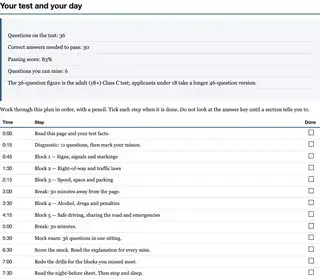
California Permit & CDL Tests: 1‑Day Study Plans
Our own study plan. Its questions are free here; its lessons are only in this plan.
- Weeks awayGet the pack — $4.99
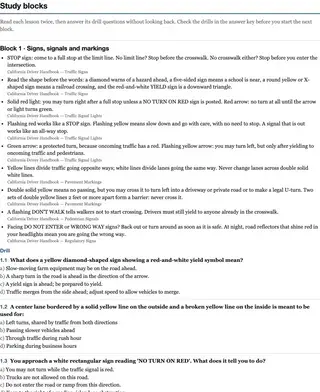
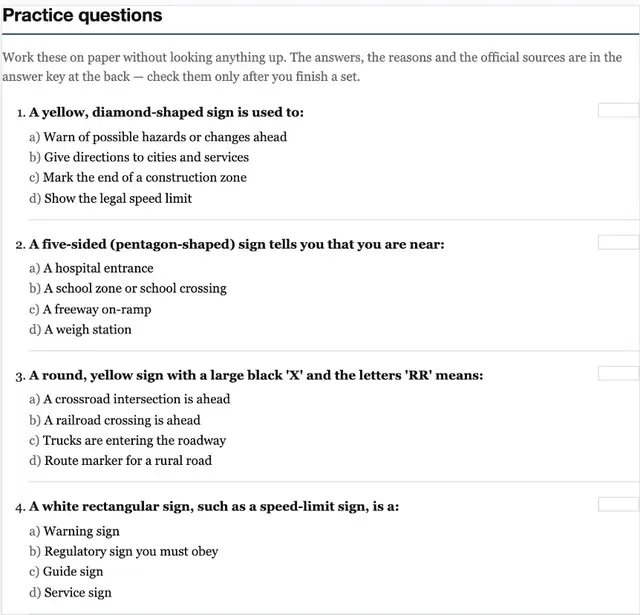
California Practice Test Pack — 2026 Printable Edition
Our own printable edition — nobody paid us to show it to you, and everything in it is free to read here too.
- One-time purchase
- Instant download
- 14-day refund
Study questions with answers
12 sample Signals & Pavement Markings questions with the correct answer, a short explanation, and the official handbook reference. Read through them, then take the quiz above.
Show all 12 questions with answers
1. A flashing yellow traffic signal light (not an arrow) means:
Correct answer: Proceed with caution; you do not need to stop
A flashing yellow signal warns you to go ahead carefully. Slow down and watch closely, but a stop is not needed. Stopping first is what a flashing red light requires. The signal is not broken, so you should not ignore it. It simply asks for care as you continue through.
Source: California Driver Handbook — Traffic Signal Lights
2. A broken white line between two lanes of traffic means:
Correct answer: Lanes go the same way; you may change lanes when safe
A broken white line separates lanes on roads with two or more lanes going the same direction. You may change lanes across it when it is safe, after signaling and checking your blind spots. Traffic in opposite directions is divided by yellow lines, so a white line never means oncoming traffic is in the next lane.
3. A flashing red traffic signal means you should:
Correct answer: Stop, then go when it is safe
A flashing red signal means STOP, the same as a stop sign. After stopping, you may go when it is safe. Slowing down and proceeding with caution is what a flashing yellow light asks for, so mixing the two up is risky. You cannot treat a flashing red as optional or simply roll through it.
4. A steady green arrow pointing left at a traffic signal means:
Correct answer: You may turn in the arrow's direction; oncoming traffic is stopped
A green arrow means go in the direction it points, giving you a protected turn, because oncoming vehicles are stopped by a red light. You do not need to wait or give way to traffic that is held at a red signal. Still yield to pedestrians, and remember that a red arrow is a stop signal.
5. A flashing yellow left-turn arrow tells you that you may:
Correct answer: Turn left after yielding to oncoming traffic
A flashing yellow left-turn arrow means you can turn, but the turn is not protected from other traffic. Turn left only after yielding to oncoming traffic, and proceed with caution. A steady green arrow is the protected turn, where oncoming vehicles are stopped, so do not treat the flashing yellow arrow as one.
Source: California Driver Handbook — Traffic Signal Lights
6. Double solid white lines separating a regular lane from a carpool (HOV) lane mean you should:
Correct answer: Never cross them; wait for a broken white line section
Double solid white lines form a lane barrier between a regular lane and a preferential lane such as a carpool lane. Never change lanes over them, even if you qualify to use the carpool lane. Wait until you see a single broken white line, and use the designated entrances and exits instead.
Source: California Driver Handbook — Pavement Markings
7. A row of solid white triangles painted across a lane, pointing toward approaching traffic, is called a:
Correct answer: Yield line
A line of solid white triangles across a lane is a yield line. It shows approaching vehicles where to yield or stop, and the triangles point toward the traffic that must yield. It is not a crosswalk boundary, a bike lane marker, or a passing marker, which use different markings. Stop or slow before the line when needed.
Source: California Driver Handbook — Pavement Markings
8. You approach an intersection where the traffic signals are completely dark and not working. You should:
Correct answer: Treat it as an all-way (four-way) stop
When a traffic signal is not working, stop as if the intersection had STOP signs in all directions. Then go cautiously when it is safe, taking turns using the normal right-of-way rules. Driving through without slowing, or treating it as a green light, risks a crash, so a dark signal is not a green light.
9. A center lane bordered by a solid yellow line on the outside and a broken yellow line on the inside is meant to be used for:
Correct answer: Left turns, shared by traffic from both directions
A center left turn lane sits in the middle of a two-way street, marked by a broken inner line and a solid outer line. You use it to get ready for a left turn or U-turn and then make it. It is not a passing lane or a regular travel lane, and you may drive in it for only 200 feet.
Source: California Driver Handbook — Pavement Markings / Turn Lanes
10. A broken (dashed) yellow center line means:
Correct answer: You may pass when it is safe
A broken yellow line next to your lane means you may pass, but only when it is safe to do so. It is the center-line marking for a two-way road, not a ban on passing and not a one-way indicator. A solid yellow line on your side is what forbids passing, so check which type of line borders your lane.
11. A steady yellow traffic light means:
Correct answer: The light is about to turn red; stop if you safely can
A steady yellow light means caution: the light is about to turn red. Stop when you can do it safely. If a safe stop is not possible, cross the intersection cautiously rather than slamming on the brakes. Speeding up to beat the light is not what the rule asks for, and the yellow phase is a warning, not extra time to go.
12. Two solid yellow lines painted down the center of a road mean:
Correct answer: Do not pass; cross only to turn left
Double solid yellow lines mean you must not pass over them, and you stay to their right. The handbook allows a few exceptions: a carpool lane with a left-side entrance, signs sending you across because your side is blocked, and a left turn over one pair of double yellow lines into or out of a private road or driveway, or for a U-turn. The idea that both directions may pass is wrong.
More Car / Permit topics
Practice Signals & Pavement Markings in another state
Every California question is written from the official California driver handbook and checked against its current edition. DMV Test Free is a free, independent study resource — not affiliated with any DMV or government agency. About DMV Test Free
Study offline
California Practice Test Pack — 2026 Printable Edition
$4.99 · One-time purchase. Instant download.
Our own printable edition — nobody paid us to show it to you, and everything in it is free to read here too.